

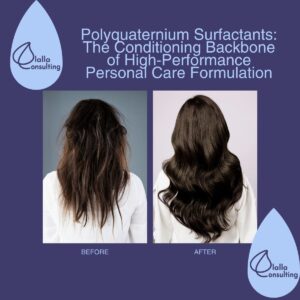
 Polyquaterniums continue to be some of the most effective and reliable conditioning polymers in modern hair care and skin care formulation, and their role in delivering sensory performance, deposition and overall consumer satisfaction remains unmatched. Their permanent cationic charge, diverse molecular architectures and controlled interactions with surfactants allow formulators to achieve exceptional conditioning, smoother textures and balanced cleansing systems. Because their chemistry determines everything from viscosity to sensorial payoff, they are essential building blocks for high‑performance shampoos, conditioners and hybrid treatments.
Having designed over 500 hair and skin formulations for premium and mass brands globally, I’ve seen how the wrong polymer choice can break a product, and how the right one can transform consumer perception. Polyquaterniums cannot be used interchangeably, since their backbone structure, molecular weight and charge distribution control compatibility, deposition and sensory impact. These differences influence whether a product feels silky or plush, whether it offers volume or slip and whether it maintains clarity, foam and stability.
Search products with industry certifications like ECOCERT, COSMOS, USDA Organic, Natural Products Association and more. Discover Prospector Premium.
Hair and parts of the skin barrier hold a natural negative charge, which increases with chemical or mechanical damage. This allows the quaternary ammonium groups in polyquaterniums to anchor consistently across cosmetic pH ranges, delivering strong substantivity and targeted deposition. Damaged hair attracts even more polymer, leading to organized film formation that aligns smoothly over the surface and enhances conditioning performance. These properties make polyquaterniums ideal for color care formulas, repair masks and advanced hair treatments designed for chemically processed or fragile hair.
In today’s market, where consumers expect professional results at home and many brands shift toward milder surfactant systems and botanical additions, the role of the cationic polymer becomes even more critical. Polyquaterniums safeguard performance and sensorial richness, this makes them essential in maintaining performance quality while supporting modern ingredient philosophies.
Key Chemical Factors That Influence Polyquaternium Performance
Polyquats differ significantly in structure. These structural factors control charge distribution, solubility, film formation and compatibility with surfactants.
1. Charge Density
Charge density controls how strongly the polymer binds to the hair or skin substrate. High charge density increases substantivity, yet one may have to control the polyquaternium buildup. While lower charge density improves surfactant compatibility and reduces heaviness, a balance essential for fine hair or frequent‑wash systems.
2. Backbone Structure
Polyquats may be cellulose‑based, acrylic or DMDAAC derivatives, each offering a different film type and sensory outcome:
- Cellulosic polymers provide flexible films and natural slip.
- Acrylic and VP copolymers offer cohesive films that support styling hold.
- DMDAAC polymers deliver strong substantivity and more assertive deposition.
3. Molecular Weight
Molecular weight in conditioning polymers shapes film thickness and deposition strength. High molecular weight film formers build rich, surface‑bound films. low molecular weight materials may penetrate superficial skin layers, influencing moisturization.
4. Hydrophobic Modification
Fatty side chains are used as slip enhancement ingredients to improve slip while brushing, increase lubricity and create sensory effects making them perfect candidates for premium hair conditioning agents, especially in masks and leave‑on products.
Key Polyquaternium Types and Their Functional Profiles
Polyquaternium‑7
A copolymer of DMDAAC and acrylamide with reduced charge density, which improves compatibility with anionic surfactants. It is one of the most widely used synthetic cationic polymers in cleansing systems, transparent shampoos, mild surfactant systems, everyday cleansing, delivering soft, moisturized after-feel.
Polyquaternium 10
A quaternised hydroxyethyl cellulose derivative. These polymers vary in molecular weight and cationic substitution level and are known for strong substantivity and ability to protect against anionic surfactant aggression. They provide viscosity contribution, smoothness and natural slip in both premium shampoos and conditioners with anti‑breakage claims.
Polyquaternium 11
A quaternised copolymer of DMAEMA. It forms cohesive films with strong substantivity and is used in both cleansing and styling systems. Molecular weight can vary widely, giving formulators flexibility in film strength and deposition.
Polyquaternium 70
A polyquat salt based on ethoxylated and propoxylated stearyl amine condensed and then quaternised. It offers strong conditioning and sensory performance, often used in premium hair care where shine, slip and humidity resistance are important.
Cationic guar derivatives
Guar hydroxypropyl trimonium chloride and related materials provide film formation, softness and anti-irritant behavior. Compatible with mild surfactant systems and suitable for naturally positioned formulations such as sulphate-free systems.
Formulation Challenges and Opportunities
Polyquaterniums interact with surfactants, electrolytes, proteins and natural extracts. Subtle formulation changes can significantly influence viscosity, clarity and deposition. This is where experience becomes essential in guiding formulation strategy.
How surfactant type alters polymer conformation
Anionic surfactants partially shield the polymer’s cationic sites. This reduces the charge available for binding to hair, lowering deposition during the wash stage. However, during rinsing when surfactant concentration drops, the complex can collapse, releasing parts of the polymer back onto the hair. This is a key mechanism behind the conditioning effect of many 2 in 1 shampoos.
Amphoteric surfactants such as cocamidopropyl betaine can stabilize complexes and reduce excessive viscosity thickening. Non-ionic surfactants interact minimally with the polymer and support clarity in transparent systems.
Competition for binding sites
Both surfactants and polymers compete for the negatively charged sites on hair and skin. High anionic surfactant levels can dominate the surface, reducing polymer deposition. Conversely, damaged hair with stronger negative charge can attract more polymer despite the presence of anionics.
Why Polyquaterniums Remain Indispensable in Modern Formulation
Even as new bio based and protein-based conditioners emerge, polyquaterniums remain cornerstones of performance, especially in systems where consistency, substantivity and sensory control are essential. Their versatility makes them a foundation for both mass market and premium product design.
Partner with Olalla Consulting for advanced formulation support
With decades of experience in polymer chemistry, surfactant science and the development of market ready formulations for global beauty brands, Olalla Consulting helps bring clarity and strategy to complex formulation challenges. If you’re reformulating for milder systems, upgrading sensorial payoff, or troubleshooting deposition issues, we help teams accelerate development with clarity and robust testing logic
Learn more at https://www.olallaconsulting.com.

The views, opinions and technical analyses presented here are those of the author or advertiser, and are not necessarily those of ULProspector.com or UL Solutions. The appearance of this content in the UL Prospector Knowledge Center does not constitute an endorsement by UL Solutions or its affiliates.
All content is subject to copyright and may not be reproduced without prior authorization from UL Solutions or the content author.
The content has been made available for informational and educational purposes only. While the editors of this site may verify the accuracy of its content from time to time, we assume no responsibility for errors made by the author, editorial staff or any other contributor.
UL Solutions does not make any representations or warranties with respect to the accuracy, applicability, fitness or completeness of the content. UL Solutions does not warrant the performance, effectiveness or applicability of sites listed or linked to in any content.