Hair conditioners may appear deceptively simple, but they are among the most elegant examples of applied colloid and surface chemistry in the personal care industry. Unlike cleansing products, whose primary function occurs during use, conditioners must be engineered to deposit beneficial materials onto the hair fibre and remain effective after rinsing.
The challenge for formulators is therefore twofold: creating a physically stable product while simultaneously optimizing the delivery of conditioning agents to damaged areas of the hair.
Most rinse off conditioners are structured as oil in water emulsions built around a conditioning network composed of cationic surfactants, fatty alcohols, water, and additional performance ingredients. The architecture of this network has a profound impact on product aesthetics, deposition efficiency, and long-term stability.
Understanding Hair Conditioning Mechanisms
Hair fibres naturally carry a negative charge, particularly when damaged through bleaching, colouring, heat styling, or environmental exposure. Conditioners are specifically designed to reduce friction, improve manageability, and restore a healthy appearance by depositing conditioning agents onto the hair surface.
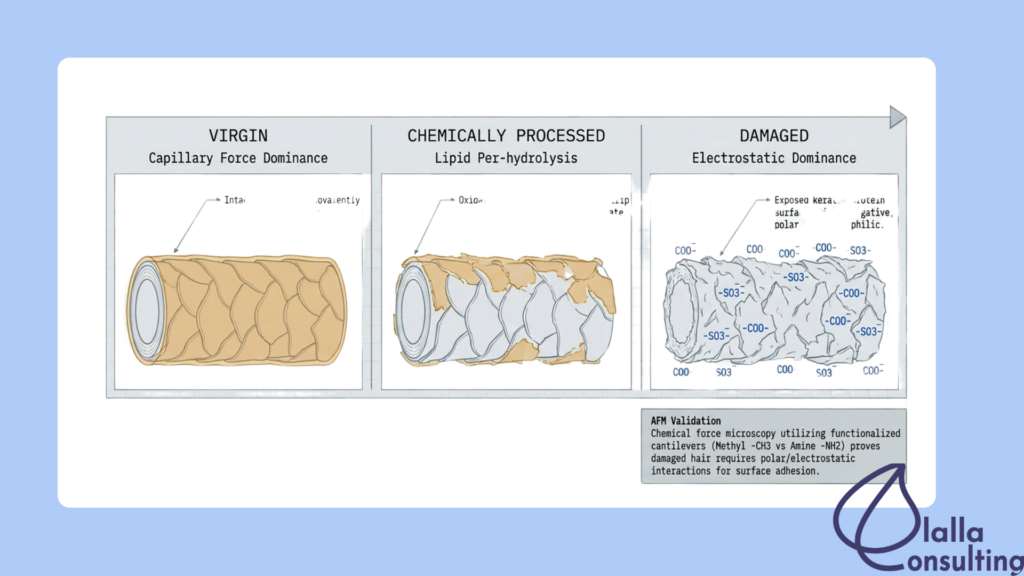 The most effective conditioning ingredients are cationic materials, which possess a positive charge. These ingredients are attracted to negatively charged areas of the hair shaft, allowing them to remain substantive even after rinsing. This electrostatic interaction is one of the key reasons conditioners are able to improve combability, reduce static, and enhance softness.
In addition to charge-based interactions, conditioners also create lubricating films that help smooth the cuticle surface. A smoother cuticle reflects light more uniformly, resulting in improved shine and a healthier visual appearance.
Building the Conditioner Chassis
At the heart of most conditioner formulations is a combination of fatty alcohols and cationic surfactants. Together, these materials form organized lamellar liquid crystal structures that give conditioners their characteristic creamy texture.
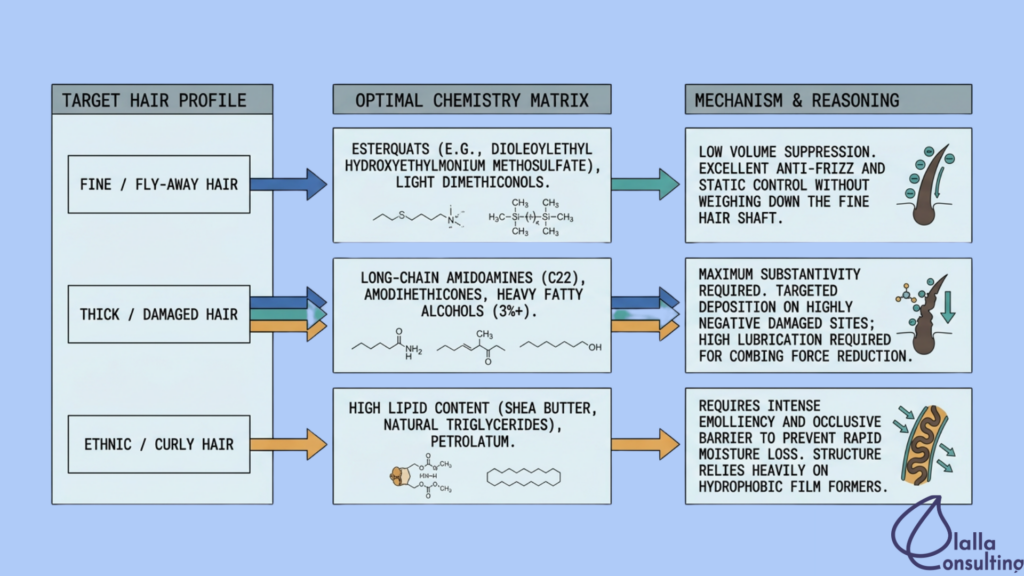 These structures perform several functions simultaneously. They stabilize the emulsion, contribute viscosity, improve spreading during application, and act as reservoirs that control the release of conditioning agents onto the hair surface.
This is why the ratio between fatty alcohols and cationic surfactants is often more important than the concentration of either ingredient alone. Small changes in this balance can dramatically affect viscosity, rinsability, deposition, and consumer perception.
Among the most widely used conditioning surfactants are:
Stearamidopropyl Dimethylamine
Behenamidopropyl Dimethylamine
For premium conditioners intended for damaged or textured hair, Behentrimonium Chloride remains a benchmark ingredient due to its exceptional detangling and smoothing performance.
Layering In Performance Actives
Once the chassis is dialled in, silicones and cationic polymers do the heavy lifting on slip, shine and manageability. Dimethicone delivers everyday smoothness, while amodimethicone, thanks to its amine functionality, targets negatively charged damaged sites with real precision. Polyquaternium ingredients such as Polyquaternium 10 and Polyquaternium 7 are essential in two in one shampoos, staying soluble during cleansing and depositing only once the surfactant concentration drops during rinsing.
Hydrolysed proteins and low molecular weight amino acids round out the repair story, penetrating the cuticle to reinforce the cortex and restore moisture balance after bleaching, colouring or heat styling. Humectants like glycerine and propylene glycol add another dimension, though they perform best in leave on products since they are water soluble and can rinse away in wash off formulas.
Choosing the Right Conditioning Technology
Not all conditioning agents behave in the same way.
Traditional quaternary ammonium compounds provide excellent lubrication and antistatic performance. Ingredients such as Behentrimonium Chloride are often selected for intensive repair products because their long alkyl chains create highly lubricating surface films.
Amidoamines represent another important class of conditioning materials. Once neutralized with an acid, they become cationic in the formulation and provide excellent conditioning while often offering improved environmental profiles compared to traditional quats.
Looking for product certifications and regulatory compliance information to assist with your development process? Upgrade your Prospector account today. Learn more here!
The choice between these technologies depends on the target hair type, desired sensory profile, regulatory considerations, and sustainability goals.
Formulating for Damaged, Coloured and Textured Hair
Not all hair behaves the same way, and neither should your formula. Bleaching strips away the natural eighteen methyl eicosanoic acid lipid layer and oxidizes cystine into cysteic acid, dramatically increasing negative charge density. That makes bleached and colour treated hair unusually receptive to trialkyl quats, amidoamines and functional silicones, which deposit at more than double the rate seen on virgin fibre.
Colour protection adds another layer of complexity. Sealing the cuticle with volatile and non-volatile silicone blends, combined with UV filters and antioxidants, helps lock in pigment and slow photodegradation. Mild secondary surfactants such as sulfosuccinates and amphoterics are equally important here since harsh anionics like sodium lauryl sulphate strip lipids and accelerate colour fade while irritating skin and eyes.
The Future of Conditioner Formulation
Conditioner innovation is increasingly focused on smarter deposition rather than simply adding more ingredients.
New technologies are exploring biomimetic lipids, peptide-based systems, amino acid delivery, and advanced encapsulation approaches that target damaged regions of the hair more efficiently. Formulators are also exploring ways to reduce cationic load while maintaining performance, responding to both sustainability pressures and changing consumer expectations.
As our understanding of hair surface chemistry continues to advance, future conditioners are likely to become increasingly targeted, delivering benefits with greater precision and improved sensory elegance.
For today’s formulators, success lies in understanding that hair conditioning is fundamentally a surface science challenge. The most effective products are not necessarily those containing the longest ingredient lists, but those designed around intelligent deposition, optimized emulsion structure, and a deep understanding of hair fibre interactions.
Ready to Formulate Your Next Winning Conditioner?
Great hair conditioners are built on the right chemistry, the right process and the right ingredient partners. Ready to develop a conditioner that performs beautifully, claims credibly and stands up to real-world formulation challenges?
References:
- Holmberg, K., Jönsson, B., Kronberg, B., and Lindman, B. (2002). Surfactants and Polymers in Aqueous Solution. John Wiley & Sons, Ltd.
- Tai, A., et al. (2014). “Texture analysis of cosmetic pharmaceutical raw materials and formulations.” International Journal of Cosmetic Science, 36, 291–304.
- Santos, J. S., Barradas, T. N., and Tavares, G. D. (2022). “Advances in nanotechnology-based hair care products applied to hair shaft and hair scalp disorders.” International Journal of Cosmetic Science, 44, 320–332.
- Labarre, L., et al. (2023). “Hair surface interactions against different chemical functional groups as a function of environment and hair condition.” International Journal of Cosmetic Science, 45, 224–235.
- Ho Tan Tai, L. (2000). Formulating Detergents and Personal Care Products: A Guide to Product Development. AOCS Press.
- Bibette, J. (2007). Emulsion Science: Basic Principles. Springer Science Business Media, LLC.
- Barel, A. O., Paye, M., and Maibach, H. I., eds. (2009). Handbook of Cosmetic Science and Technology. 3rd ed. Informa Healthcare USA, Inc.
- Flick, E. W. (1991). Cosmetics Additives: An Industrial Guide. Noyes Publications.

The views, opinions and technical analyses presented here are those of the author or advertiser, and are not necessarily those of ULProspector.com or UL Solutions. The appearance of this content in the UL Prospector Knowledge Center does not constitute an endorsement by UL Solutions or its affiliates.
All content is subject to copyright and may not be reproduced without prior authorization from UL Solutions or the content author.
The content has been made available for informational and educational purposes only. While the editors of this site may verify the accuracy of its content from time to time, we assume no responsibility for errors made by the author, editorial staff or any other contributor.
UL Solutions does not make any representations or warranties with respect to the accuracy, applicability, fitness or completeness of the content. UL Solutions does not warrant the performance, effectiveness or applicability of sites listed or linked to in any content.