

 Most paints and inks contain solid particles, mostly pigments and/or fillers. Two instability problems, flocculation (the spontaneous gluing together of separated particles because of particle-to-particle attraction)1,2 and sedimentation (the sinking of particles because of gravity), can occur with solid particles that have been separated from each other and distributed in a liquid ink, paint or pigment concentrate. This article describes the basics of sedimentation and how to prevent this undesired phenomenon.
Sedimentation defined
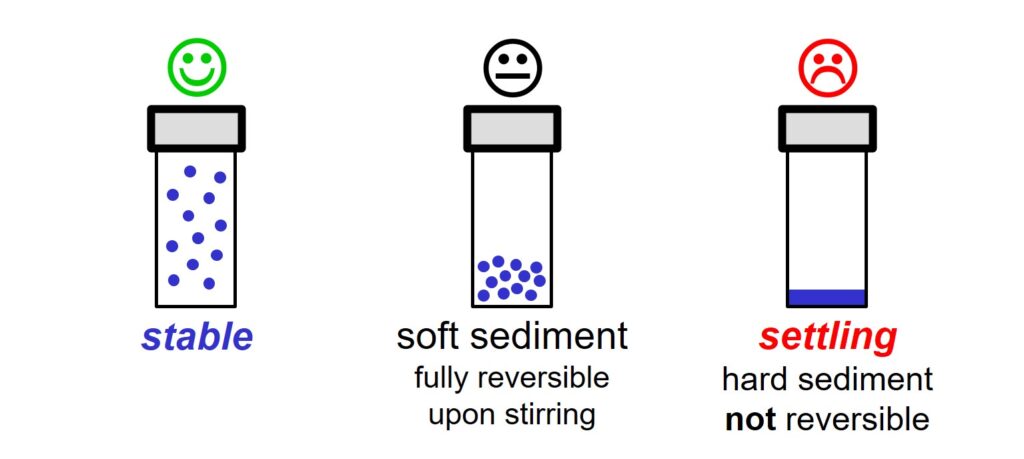
Sedimentation is the process of solid particles sinking in a liquid because of gravity. In extreme cases, particles can cluster together on the bottom of the can because of sedimentation. This highly undesired phenomenon, resulting in the formation of a hard or rubbery sediment, is called settling3.
The basics of sedimentation
Solid particles in a liquid are pulled down because of gravitational force. The cause of this phenomenon is that many solids have a density that is higher than the density of the surrounding liquid. The process of particles sinking, called sedimentation, causes problems during storage and transport. The speed of sedimentation is governed by a few properties.
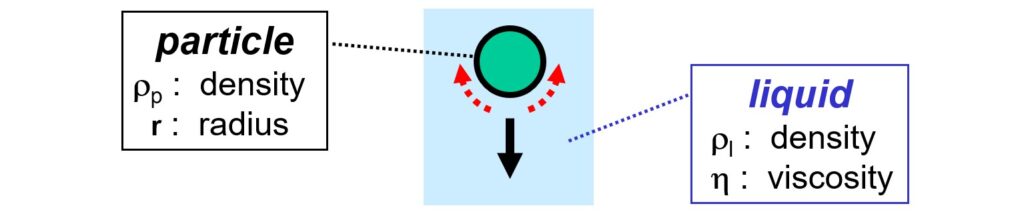
The equation that describes sedimentation velocity v of a solid particle of perfect spherical shape in a Newtonian liquid was derived by Sir George Stokes.
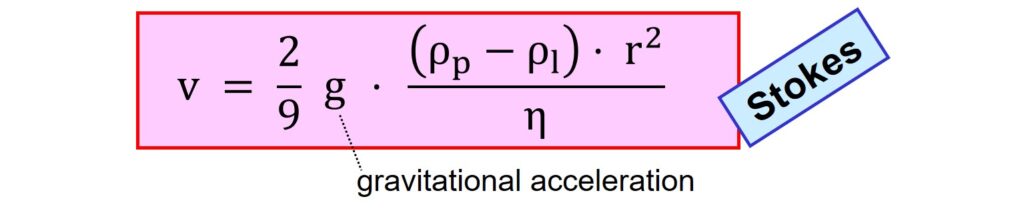
The Stokes equation shows that three factors govern how fast a particle, that is surrounded by liquid, sinks. The density of the particle, or, to be more precise, the difference between the density of the particle and the density of the surrounding liquid, is important. The second factor is size: big particles sink faster than small particles. The sedimentation velocity of a spherical particle is proportional to the square of the radius of the particle (r2). The third factor is the viscosity of the surrounding liquid. A particle goes faster down in a liquid of low viscosity. The Stokes equation is valid for smooth particles of spherical shape.
ULTRUS™ Product Stewardship enables material selection, compliance, sustainability and chemical management throughout the product life cycle to meet regulatory requirements and consumer demands. Learn more here!
A fourth factor, governing how fast a particle sinks, is the shape of the particle.
Prevent sedimentation
To understand how sedimentation can be prevented, we must take into consideration that sedimentation is mainly a problem that occurs during storage and transport of a paint or ink. During storage, the material stands still and the only force acting on the material is gravity. The only way to prevent particles from going down is by assuring that a reversible three-dimensional physical network is present in the material during storage.
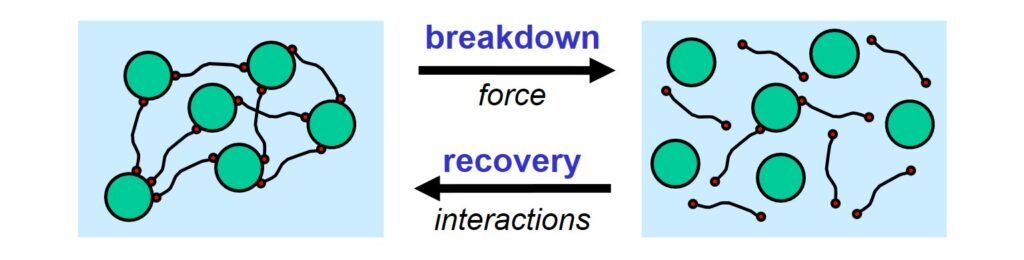
The physical network must be strong enough to give the material a so-called yield stress, also called yield value or yield point. When a material has a yield stress, it implies that during storage, at low shear stress, the material behaves as an elastic solid. This implies that the material has an infinite viscosity during storage. The solid particles are ‘frozen-in’ and sedimentation is prevented. The network is broken down, and the material becomes fluid again, when enough force is applied, for example by stirring.
Check sedimentation stability
Some companies have a sophisticated rheometer that is capable of measuring yield stress. Most paint and ink producers, however, must rely on simple storage tests, in which samples are stored in an oven at elevated temperature, like 50 or 60 °C. An attention point is that during such standing-still tests, stability under movement, like in a truck or on a ship, is not take into account. This can give unpleasant surprises.
Additives to prevent sedimentation
A reversible physical network can be created in a liquid paint or ink by using an additive, often referred to as anti-settling agent. The additive is designed to prevent sedimentation and settling. The physical network must be strong enough to resist the gravitational force during storage as well as the combination of gravity and shaking during transport. On the other hand, the network must be weak enough to be broken down as soon as sufficient shear force is applied. A range of additives has been developed for a wide variety of paints and inks.
A few examples of additives, used to prevent sedimentation:
- Fumed silica consists of small solid particles that build a reversible physical network in a material at low shear stress. Many fumed silicas are available, including products from Evonik.
- Certain solid particles with a platelet shape can form a house-of-cards structure in a paint during storage. Well-known are the smectite clays, like Bentone® products from Elementis.
- Special polymers, designed for the purpose, can also build a reversible physical network in a paint or ink, for example: polyurethanes, polyacrylates, modified urea’s and cellulose ethers.
Bio-based materials
The interest in bio-based raw materials for paints and inks increases. Two bio-based additives that are used to prevent sedimentation during storage and transport of waterbased paints are of special interest:
- Microfibrillated cellulose (MFC) consists of a three-dimensional network of natural cellulose fibrils4. MFC does not dissolve in water. The cellulose fibrils are present as finely divided solid cellulose branches suspended in water. The reversible physical network is obtained via entanglement of the fibrils, in combination with hydrogen bonding, thus giving a high yield stress in waterbased paints. A commercially available MFC product is Exilva® from Borregaard.
- Xanthan gum is a high molecular weight polysaccharide that is fully water soluble. A commercial xanthan gum for waterbased paints is Vanzan® from Vanderbilt Minerals.
Adding less than 1 percent of an anti-settling agent is enough to fully prevent sedimentation during storage and transport of a paint or ink, provided that the right type of additive is selected for the system.
References
- Dispersant Agents – How to avoid unwanted consequences, Marc Hirsch, 25 September 2024.
- The Basics of Dispersion and Stabilization of Pigments and Fillers, Jochum Beetsma, 12 February 2025.
- Settle Down: Factors that Influence Pigment Settling and Stability, George Deckner, 12 May 2017.
- Let’s Get Technical: Best Personal Care Formulation Technology of 2017, George Deckner, 19 January 2018.

The views, opinions and technical analyses presented here are those of the author or advertiser, and are not necessarily those of ULProspector.com or UL Solutions. The appearance of this content in the UL Prospector Knowledge Center does not constitute an endorsement by UL Solutions or its affiliates.
All content is subject to copyright and may not be reproduced without prior authorization from UL Solutions or the content author.
The content has been made available for informational and educational purposes only. While the editors of this site may verify the accuracy of its content from time to time, we assume no responsibility for errors made by the author, editorial staff or any other contributor.
UL Solutions does not make any representations or warranties with respect to the accuracy, applicability, fitness or completeness of the content. UL Solutions does not warrant the performance, effectiveness or applicability of sites listed or linked to in any content.