

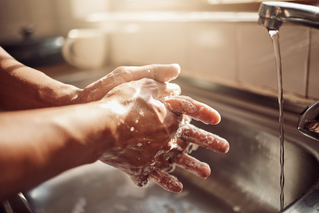
 As hygiene expectations continue to rise across household, institutional, healthcare, and food processing markets, formulators are increasingly exploring ways to extend protection beyond the cleaning event itself. Antibacterial coating technologies incorporated into cleaners offer a potential solution by depositing a functional layer on surfaces that can inhibit microbial growth between cleaning cycles.
For product developers, however, creating a cleaner that both cleans effectively and leaves a durable antibacterial coating is far more complex than simply adding a biocide. Success requires balancing efficacy, durability, surface compatibility, safety, regulatory compliance, and cost.
Understanding Antibacterial Coatings
Antibacterial coatings are designed to either kill microorganisms or prevent them from attaching to surfaces. Antimicrobial coatings actively destroy bacteria, while antifouling technologies reduce microbial adhesion and biofilm formation. Some modern systems combine both approaches to improve overall performance.[i], [ii], [iii]
Coatings generally work through one of two mechanisms:
- Release based systems, which gradually release active substances such as metal ions or natural antimicrobials.
- Contact active systems, where bacteria are killed when they come into direct contact with the treated surface.
For cleaner formulations, the challenge is creating a system that deposits sufficient active material during normal use while maintaining cleaning performance.
Key Formulation Technologies
Quaternary Ammonium Compounds
Quaternary ammonium compounds (QACs) remain among the most common antibacterial technologies in cleaners. In addition to disinfection, certain QACs leave residual deposits that can provide ongoing antimicrobial activity. Their broad-spectrum performance and formulation flexibility make them attractive for hard surface cleaners.[iv], ii, iii, [v]
However, formulators must carefully evaluate compatibility with surfactants and assess residue levels, particularly for food contact applications.
Metal Based Technologies
Silver, copper, and zinc technologies are widely used in antimicrobial coatings. Silver releases ions that disrupt microbial metabolism, while copper generates reactive species that damage proteins and DNA. Copper can be particularly effective under dry conditions where silver performance may decline. iv, ii, iii, v
The main formulation challenges include cost, potential leaching, and regulatory scrutiny due to the potential of inducing Argyria.
ULTRUS® Software solutions: power resilient growth. Learn more here!
Natural Antimicrobial Systems
Demand for sustainable solutions has increased interest in essential oils and bio-based actives. Thyme, oregano, cinnamon, clove, and lemongrass oils demonstrate particularly strong antimicrobial activity due to compounds such as thymol, carvacrol, eugenol, and cinnamaldehyde. These are increasingly used as multifunctional materials. [vi], [vii], [viii]
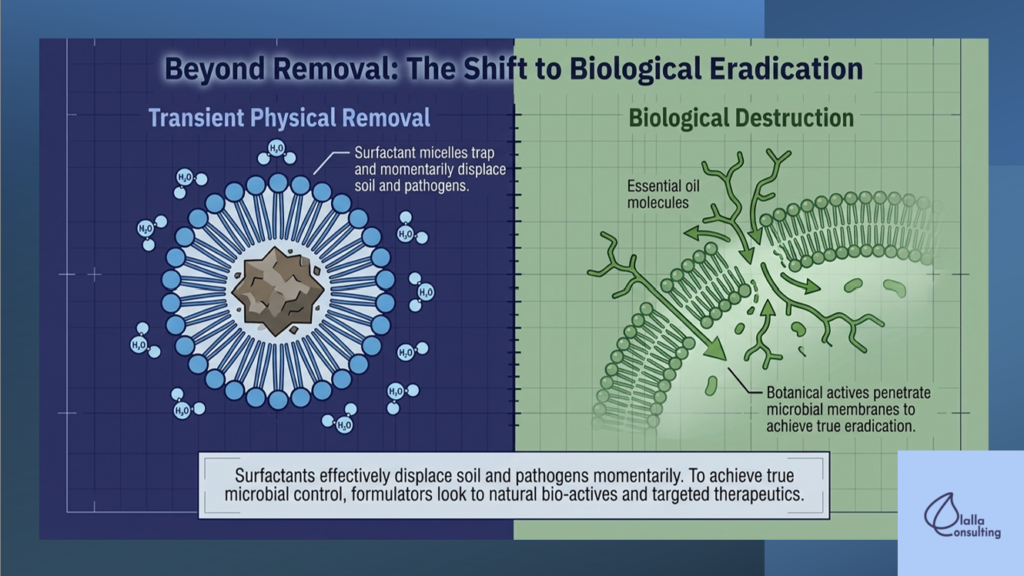 These materials can support marketing claims around naturally derived ingredients, although stability, fragrance impact, and long-term efficacy must be addressed. In Europe only a hand full of this materials are allowed as active biocidal materials highlighted in the article 95 of the BPR. However, in the simplified registration this is lowered to 2 Peppermint and lavender oils. Which can be used in combination with other actives, which makes the research a minefield of patents particularly in combination with lactic or citric acids.
Advanced Coating Technologies
Photocatalytic coatings based on titanium dioxide generate reactive oxygen species when exposed to light, providing broad spectrum antimicrobial activity against bacteria, fungi, and viruses.
Other emerging technologies include N-halamine systems that can be recharged using dilute bleach solutions, hybrid polymer coatings, and engineered antifouling surfaces designed to prevent biofilm attachment. ii, iii
Formulation Challenges
One of the biggest hurdles in antibacterial cleaner development is ensuring that the deposited coating survives real world conditions.
Mechanical wear, repeated cleaning, ultraviolet exposure, and harsh chemicals can rapidly reduce coating performance. For example, many spray applied antimicrobial coatings fail to retain efficacy following abrasion and bleach exposure, while certain triclosan based systems show significant performance loss after prolonged UV exposure. iv, [ix]
Formulators must also consider:
- Cleaning efficacy
- Deposition efficiency
- Surface compatibility
- Coating transparency
- Stability during storage
- Cost effectiveness
- Consumer safety
The interaction between polymers, surfactants, solvents, and antimicrobial agents can significantly impact coating formation and durability.
Benefits of Antibacterial Coatings in Cleaners
When properly designed, antibacterial coating technologies can provide significant advantages.
First, they may help reduce surface recontamination between cleaning cycles. This is particularly valuable in high traffic environments where surfaces can quickly become contaminated after cleaning. ix, iii, [x]
Second, coatings can help address challenges associated with biofilm formation. Certain antibiofilm technologies prevent bacteria from adhering to surfaces and developing communities that are more resistant to cleaning and disinfection. iii, v
Third, antibacterial coatings offer product differentiation. In a crowded market, cleaners that provide both cleaning and residual protection can support premium positioning and stronger value propositions.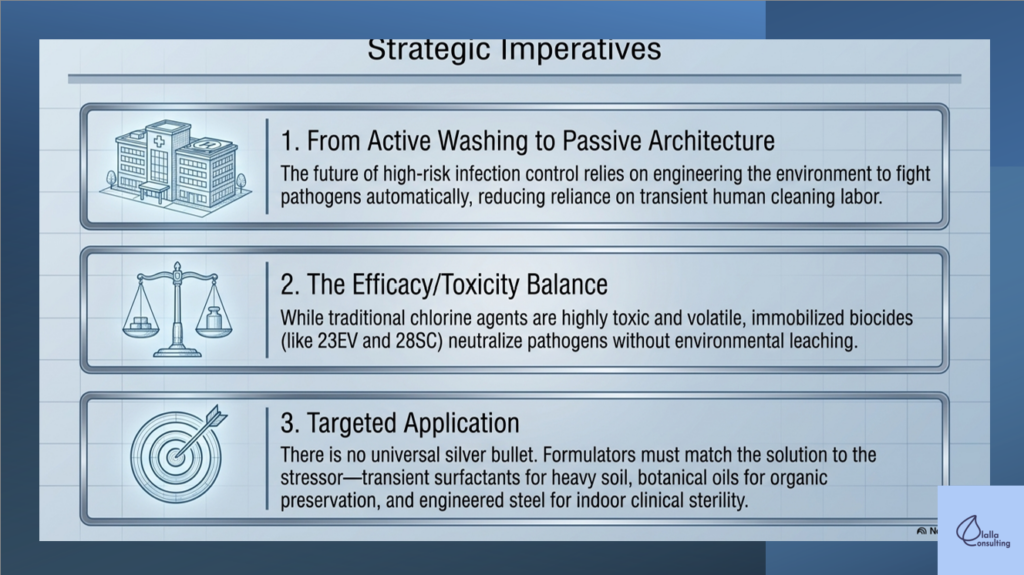
- Understanding the Risks: Despite their benefits, antibacterial coating technologies present several risks.
- Durability Concerns: Many coatings lose effectiveness over time due to abrasion, UV degradation, cleaning chemicals, or depletion of active ingredients. ii, iii, iv, v, ix
- Toxicity and Environmental Impact: Leaching of active materials such as silver ions or triclosan may create environmental concerns and potential risks to non-target organisms. i, ii, [xi]
- Antimicrobial Resistance: One of the most significant concerns is antimicrobial resistance. If coatings provide only sublethal activity, they may contribute to the selection of resistant strains or encourage the spread of resistance genes. i,ii, xi
- Regulatory Challenges: Claims such as “kills bacteria” or “provides ongoing protection” face increasing regulatory scrutiny. Requirements under EPA, FIFRA, EU Biocidal Products Regulation, REACH, and food contact regulations often require extensive efficacy and durability testing. i, ii, iv, ix, xi
Summary
Antibacterial coating technologies present a compelling opportunity for cleaner formulators seeking to deliver performance beyond traditional cleaning. However, successful products require more than antimicrobial actives alone. Durability, formulation compatibility, safety, resistance management, and regulatory compliance must be considered from the earliest development stages.
As the market continues to evolve, formulations that combine effective cleaning with scientifically validated and durable antibacterial surface protection are likely to drive the next generation of hygiene innovation.
References
[i] Fu H, Gray KA. The key to maximizing the benefits of antimicrobial and self-cleaning coatings is to fully determine their risks. Curr Opin Chem Eng. 2021;34:100761.
[ii] Edo, G.I., Mafe, A.N., Ali, A.B.M. et al. Evaluation of different antimicrobial polymeric coatings for food contact surfaces. Discov Food 5, 179 (2025). https://doi.org/10.1007/s44187-025-00487-3
[iii] Jose A, Gizdavic-Nikolaidis M, Swift S. Antimicrobial Coatings: Reviewing Options for Healthcare Applications. Appl Microbiol. 2023;3(1):145-74.
[iv] Chen WC, Ho MH, Yuan SH, Chou HW, Chang CC, Chen CH, et al. The Evaluation of Antibacterial Coatings Against Commonly Found Pathogenic Bacteria in the Environment—Implications for Environmental Safety and Infection Prevention. Pathogens. 2025;14(1):13.
[v] Bento de Carvalho T, Barbosa JB, Teixeira P. Effectiveness and Durability of a Quaternary Ammonium Compounds-Based Surface Coating to Reduce Surface Contamination. Biology. 2023;12(5):669.
[vi] Sartoratto A, Machado ALM, Delarmelina C, Figueira GM, Duarte MCT, Rehder VLG. Composition and antimicrobial activity of essential oils from aromatic plants used in Brazil. Braz J Microbiol. 2004;35:275-80.
[vii] Hammer KA, Carson CF, Riley TV. Antimicrobial activity of essential oils and other plant extracts. J Appl Microbiol. 1999;86:985-90
[viii] Snyder OP. Antimicrobial Effects of Spices and Herbs. St. Paul, MN: Hospitality Institute of Technology and Management; 1997
[ix] Calfee MW, Ryan SP, Abdel-Hady A, Monge M, Aslett D, Touati A, et al. Virucidal efficacy of antimicrobial surface coatings against the enveloped bacteriophage 6. J Appl Microbiol. 2022;132(3):1813-24.
[x] Boyce JM. Modern technologies for improving cleaning and disinfection of environmental surfaces in hospitals. Antimicrob Resist Infect Control. 2016;5:10.
[xi] Dunne CP, Keinanen-Toivola MM, Kahru A, Teunissen B, Olmez H, Gouveia I, et al. Anti-microbial coating innovations to prevent infectious diseases (AMiCI): Cost action ca15114. Bioengineered. 2017;8(6):679-85.

The views, opinions and technical analyses presented here are those of the author or advertiser, and are not necessarily those of ULProspector.com or UL Solutions. The appearance of this content in the UL Prospector Knowledge Center does not constitute an endorsement by UL Solutions or its affiliates.
All content is subject to copyright and may not be reproduced without prior authorization from UL Solutions or the content author.
The content has been made available for informational and educational purposes only. While the editors of this site may verify the accuracy of its content from time to time, we assume no responsibility for errors made by the author, editorial staff or any other contributor.
UL Solutions does not make any representations or warranties with respect to the accuracy, applicability, fitness or completeness of the content. UL Solutions does not warrant the performance, effectiveness or applicability of sites listed or linked to in any content.