

A conventional thermosetting powder paint consists of solid particles. Each particle contains all components.
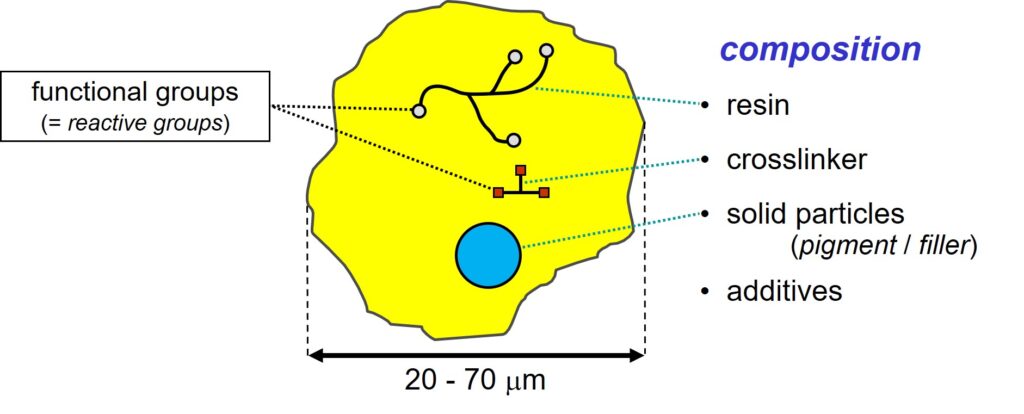
After application, the paint melts, flows and cures during film formation at high temperatures, generally in 10 to 15 minutes at 160 to 200 °C. Conventional powder paints are applied on substrates that can withstand such temperatures for a substantial time1,2. Substrates that have since long been coated with powder paint are metals like steel and aluminum.
Heat-Sensitive Substrates
A range of important substrates, like MDF (Medium Density Fiberboard), wood and plastics, cannot withstand the high temperatures that are needed for the film formation of conventional powder paints. Because of the clear advantages of powder paints, like being solvent-free and storage stable and having excellent protective, mechanical and aesthetical properties, industry is keen on developing and using powder paints that can be applied on these so-called heat-sensitive substrates (HSS). Powder paints that are used for these applications are called low temperature curing (LTC) powder paints.
The challenge
The key problem in developing and using LTC powder paints is that 2 opposite demands must be met in one system.
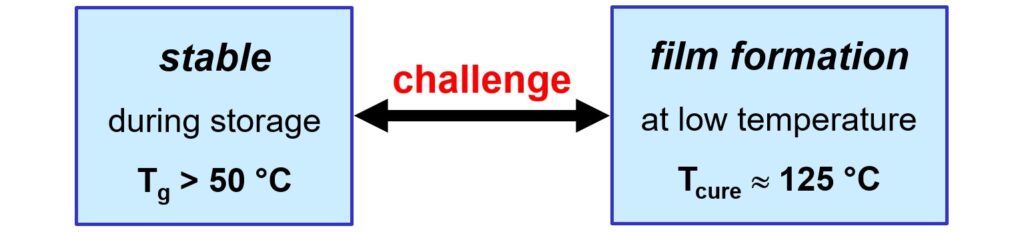
First, the powder paint must be storage stable. This implies that the solid particles must not glue together and (virtually) no chemical reaction should take place within the particles at temperatures up to at least 40 °C, but preferably up to 50 °C. The glass transition temperature (Tg) of the binder system of the powder paint must be at least 50 °C to assure good storage stability.
Secondly, the solid paint particles must melt, coalesce, flow, level and cure at temperatures at which the substrate is not damaged. For the heat-sensitive substrates mentioned, this is in the range of 90 to 130 °C.
The core of LTC powder paints
Decades ago, system developers realized that breakthroughs were needed with respect to the binder system of powder paints, consisting of resin, crosslinker and specific additives, to be able to meet the challenge of developing storage stable systems that form a strong coating at relative low temperatures. One option is to use radcure (radiation curable) powder paints, systems that cure under the influence of ultraviolet (UV) or electron beam (EB) radiation3,4. Another approach is to use mild heat to obtain good film formation at relative low temperatures.
ULTRUS® software solutions connect product life cycle data, regulatory content and expertise and AI-driven automation and analytics. Learn more here!
Unsaturated polyesters
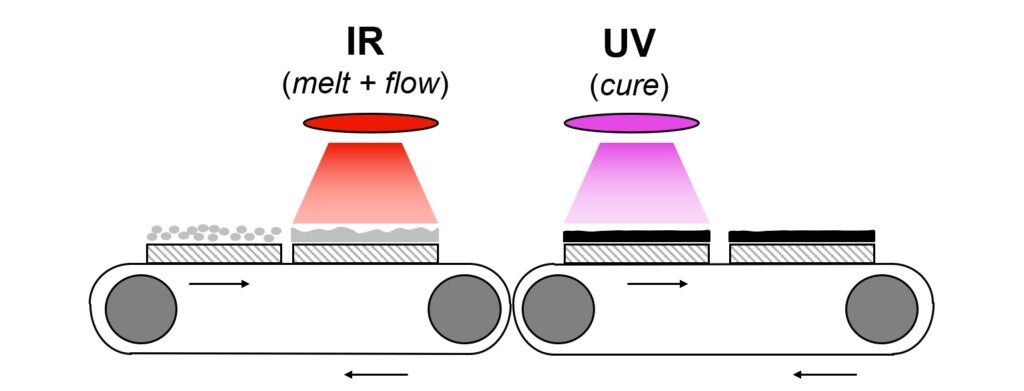
Unsaturated polyester resins contain carbon-carbon double bonds (C=C). The double bonds can crosslink during film formation, thus forming a strong chemical network. There are several ways to initiate this curing mechanism, called free radical polymerization. The first option is to use thermal peroxides that decompose under the influence of heat. Another option is to use a photoinitiator, an additive that decomposes when exposed to UV- or EB-radiation. Both peroxides and photoinitiators generate free radicals that initiate the radical polymerization reaction. The film formation of radcure powder paints takes place in two steps. First, the paint particles are molten under infrared (IR) radiation. Then, when melting, coalescence, flow and leveling are completed, cure takes place under ultraviolet (UV) radiation.
An example
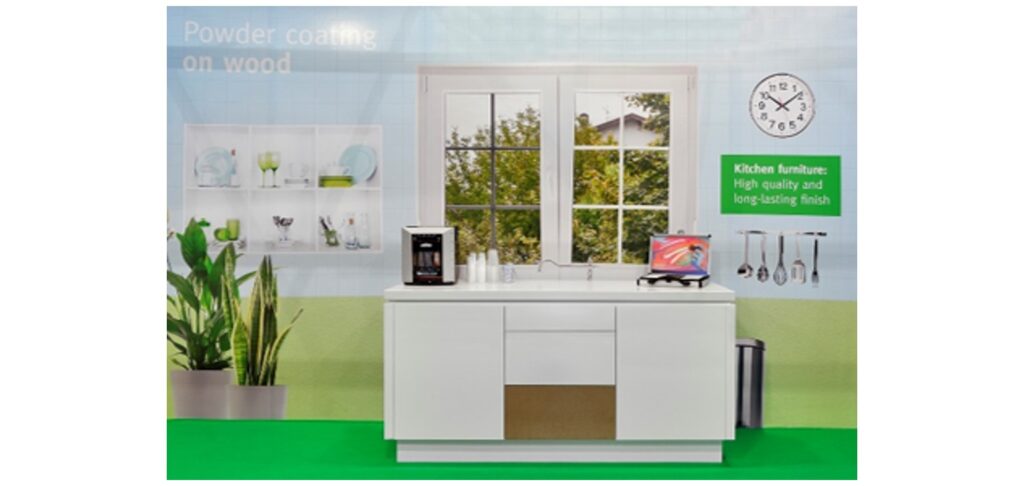
At present it is possible to apply powder paints on heat-sensitive substrates like MDF and wood. The Uralac® Ultra technology was developed by Covestro, a global leading company in resins and crosslinkers for paints. The binder system, which cures thermally in 3 minutes at only 130 °C under infrared radiation, is based on unsaturated polyester resin and peroxide initiator. LTC powder paints based on this breakthrough technology are used on commercial scale for furniture, kitchen cabinets and bathroom cabinets.
References
- Article The Basics of Powder Coatings, Jochum Beetsma, 14 May 2021, Prospector Knowledge Center
- Article The Latest Trends in Powder Coating Technology, Patricia Geelen, 13 November 2024, Prospector Knowledge Center
- Article Using UV/EB Resins in Coatings, Marc Hirsch, 21 October 2016, Prospector Knowledge Center
- Article Radiation Cure Coatings – The Ultimate in Rapid Cure Technology, Ron Lewarchik, 2 April 2021, Prospector Knowledge Center

The views, opinions and technical analyses presented here are those of the author or advertiser, and are not necessarily those of ULProspector.com or UL Solutions. The appearance of this content in the UL Prospector Knowledge Center does not constitute an endorsement by UL Solutions or its affiliates.
All content is subject to copyright and may not be reproduced without prior authorization from UL Solutions or the content author.
The content has been made available for informational and educational purposes only. While the editors of this site may verify the accuracy of its content from time to time, we assume no responsibility for errors made by the author, editorial staff or any other contributor.
UL Solutions does not make any representations or warranties with respect to the accuracy, applicability, fitness or completeness of the content. UL Solutions does not warrant the performance, effectiveness or applicability of sites listed or linked to in any content.