

by Ronald Lewarchik & Vishakha Makode
Color drenching is a design style where the entire room surfaces including walls ceiling trim, doors, built-ins and furniture is painted in the same color or very similar shades to provide the impression of cohesiveness. The resulting appearance also creates the impression that the resulting space is larger and taller. Color drenching is not simply a matter of selecting a bold shade and applying it to every surface. Achieving a truly deep, uniform, and visually rich color across walls, ceilings, furniture, or metal substrates depends on how the coating is formulated and how the dried film interacts with light. Factors such as pigment type and concentration, dispersion quality, ratio of pigment to binder, and how the film forms and levels all play a direct role in the final appearance. Small changes in any of these areas can shift a coating from looking dense and saturated to appearing flat, patchy, or muted.
When coatings are applied to different substrates—such as drywall, wood, or metal—the formulation must also accommodate differences in surface energy, absorption, porosity and texture. These variables influence how the film builds and how color is perceived. For this reason, color drenching requires careful control of raw materials, processing, and application conditions, not only in the laboratory but also during production and at the job site.
Pigment Selection and Its Impact on Color Depth
Pigments absorb specific wavelengths of light, and the efficiency of this absorption determines how intense a color appears. For drenching applications, pigments must provide high tint strength (the ability of a colorant to alter the color of another paint or substance) while remaining stable and well dispersed throughout the coating matrix.
Organic pigments are typically favored for saturated systems because they provide cleaner hues (color and shade) and stronger chroma (the intensity of color) than most inorganic pigments. This allows formulators to achieve deep color without excessive pigment loading, which helps maintain film smoothness and mechanical integrity. Inorganic pigments, while excellent for durability (i.e. light stability and heat stability), they tend to produce more muted colors and are more suitable for earth tones or pastel shades.
However, organic pigments are more sensitive to dispersion quality. Their high surface area and surface energy make them prone to flocculation if dispersant selection or grind conditions are inadequate. When pigments flocculate, clusters form that scatter light rather than absorb it efficiently, reducing saturation and causing shade variability across the surface. Proper wetting and stabilization during the grind phase are therefore essential to preserve both tint strength and uniform appearance.
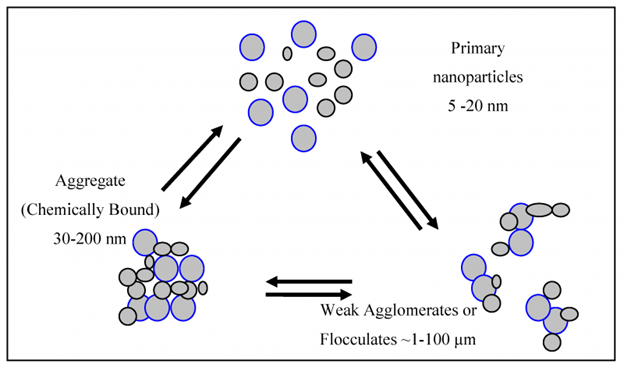
Titanium dioxide and mineral extenders also influence color depth. Titanium dioxide is highly effective at scattering light, which improves hiding but reduces saturation by reflecting light before it reaches colored pigments. Even small additions can noticeably reduce chroma. Coarse extenders similarly increase internal scattering and reduce visual richness. In many drenching systems, these materials are minimized or excluded, and hiding is managed through substrate preparation or multiple coats rather than through high opacifier loading.
Pigment Volume Concentration (PVC), CPVC, and Film Structure
Pigment loading must be evaluated not only by weight percent but also by volume fraction. This is captured by Pigment Volume Concentration (PVC), defined as the volume of pigment divided by the total volume of pigment plus binder in the dry film.
As PVC increases, pigment particles move closer together and the binder available to fill the voids between particles decreases. At a formulation-specific point known as the Critical Pigment Volume Concentration (CPVC), the binder just fills all interstitial spaces. Above CPVC, air voids begin to form, increasing porosity and altering both optical and mechanical properties.
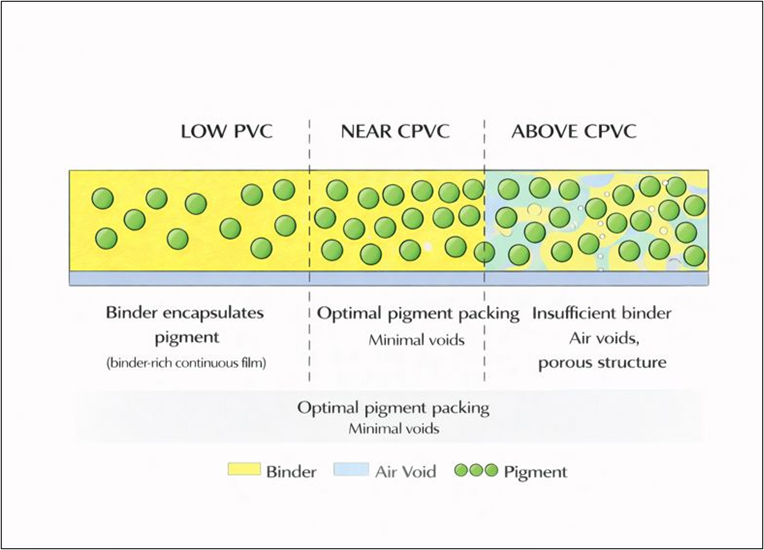
Below CPVC, binder fully surrounds pigment particles, forming a continuous film. Near CPVC, pigment packing is dense, but voids are still filled. Above CPVC, insufficient binder leads to air voids, increasing paint film paint film porosity and light scattering. porosity and light scattering.
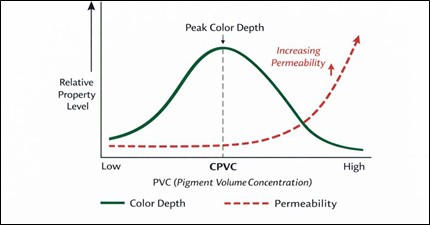
As PVC increases toward the CPVC, pigment packing density increases and color depth improves due to greater light absorption within a continuous film. Beyond CPVC, insufficient binder leads to air void formation, increasing internal light scattering and reducing perceived color saturation, while permeability rises sharply as film porosity increases.
Table 1 — PVC Regions and Visual Outcomes
| PVC Region | Film Structure | Optical Effect | Visual Appearance |
| Low PVC (< CPVC) | Binder-rich, dense film | Low scattering | Smooth surface, moderate saturation |
| Near CPVC | Tightly packed pigment, minimal voids | High absorption, low scatter | Deepest saturation, uniform tone |
| Above CPVC | Porous, air-filled structure | High scattering | Matte or chalky, reduced depth |
For color drenching, formulations are typically designed below or near CPVC, even when targeting matte finishes. Low sheen is achieved through surface texture control rather than pushing pigment loading into the porous regime.
Binder Selection and Optical Clarity
The binder determines not only mechanical properties but also how light passes through the film. A transparent binder that forms a smooth, continuous layer enables more light to penetrate the film and interact with pigment particles before being reflected back to the observer.
Acrylic binders are widely used because they offer good clarity, resistance to yellowing, and compatibility with organic pigments. Polyurethane-modified acrylics and self-crosslinking systems can further improve leveling and surface durability without introducing haze. These systems are useful when drenching is applied to trim, doors, furniture, or metal components that experience frequent contact.
Achieve regulatory compliance, supply chain transparency and meet your sustainability initiatives with WERCS Studio software. Learn more here!
Surfactant migration during drying can create subtle variations in surface chemistry and refractive index, leading to uneven sheen or slight shade shifts. This is more noticeable in saturated colors (very near the peak intensity or chroma), making surfactant control and additive compatibility important parts of formulation design.
Dispersion Quality, Rheology, and Application Effects
Even when pigment and binder are properly selected and formulated at the proper levels, poor dispersion or flow behavior can reduce saturation. Incomplete dispersion leaves pigment agglomerates that scatter light and create localized shade differences which may also be the result of flooding or floating. Rheology (the study of the deformation and flow of matter that focuses on the relationships between stress, strain, temperature and time) influences how evenly the coating spreads and whether brush or roller marks remain visible after drying.
Associative thickeners, flow modifiers, and leveling agents are used to balance sag resistance with smooth film formation. For large surfaces typical of drench applications, good leveling is critical to avoid lap marks that break visual continuity. Surface smoothness directly influences how uniformly light is reflected and/or absorbed, which affects perceived color depth.
Substrate Effects and Direct-to-Metal Applications
Substrate properties strongly affect color perception. Porous substrates can absorb binder unevenly, creating localized variations in pigment concentration and resulting in patchy or uneven appearance. Primers and sealers are often necessary to create uniform absorption and consistent surface energy before applying saturated topcoats.
When color drenching is applied to metal surfaces such as architectural features, railings, doors, or furniture —adhesion and corrosion resistance must also be considered along with appearance. In these cases, formulation principles from Direct-to-Metal (DTM) coatings become especially relevant. Resin selection, surface wetting, and pigment–binder balance must support both strong adhesion and consistent color development in a single coating layer.
Recent advances in DTM resin chemistry emphasize achieving durable adhesion, corrosion protection, and environmental compliance without the use of separate primers. These same principles including dispersion stability, film continuity, rheology and PVC optimization are equally important when saturated color is required on metal substrates. For a more detailed discussion of DTM resin chemistry, adhesion mechanisms, and performance trade-offs, refer to our recently published article on Direct-to-Metal coatings, “Direct-to-Metal Coatings: Evolving Chemistry, Elevated Performance, and Enhanced Sustainability,”
Durability Considerations in High-Chroma Coatings
Highly saturated coatings can be more sensitive to burnishing, abrasion, and surface marking, especially when formulated near CPVC with limited extender content. Increasing binder content, selecting tougher polymer backbones, or incorporating mild crosslinking can improve scrub resistance.
However, excessive hardness contributed to pigment loading can increase light scattering and reduce saturation. Achieving both durability and color depth requires balancing binder strength with optical clarity rather than relying solely on pigment loading.
Conclusion
Color drenching places greater demands on formulation than conventional decorative coatings. Deep, uniform color depends on careful pigment selection, high-quality dispersion, precise control of PVC relative to CPVC, and binder systems that support smooth, continuous film formation. Substrate interactions and durability requirements further complicate the design process, particularly when coatings are applied to metal or high-wear surfaces
References
- Critical Pigment Volume Concentration (CPVC)..
https://www.sciencedirect.com/topics/engineering/critical-pigment-volume-concentration - Lewarchik Effect of Pigment Volume Concentration on Coatings & Properties. https://www.ulprospector.com/knowledge/795/pc-pigment-volume-concentration-part-ii/
- Lewarchik Pigment Volume Concentration (PVC) in Coatings.
https://www.sciencedirect.com/topics/engineering/pigment-volume-concentration - Bierwagen, G. P. Film Formation and the Role of Pigment Packing in Coatings.
Progress in Organic Coatings, Elsevier. - Wicks, Z. W., Jones, F. N., Pappas, S. P., Wicks, D. A.
Organic Coatings: Science and Technology, 3rd Ed., Wiley. - lewarchik Dispersion and Wetting Hydrophobic Pigments and Fillers in Waterborne Apints to avoid Pigment Flooding and Floating Part II https://www.ulprospector.com/knowledge/1579/pc-hydrophobic-pigments-flooding-and-floating/
- Bentley, J. A. Optical Properties of Pigmented Coatings.
Journal of Coatings Technology and Research. - Just Paint (Golden Artist Colors).
Pigment Volume Concentration and Its Role in Color.
https://justpaint.org/pigment-volume-concentration-and-its-role-in-color/ - PPG Industries.
Understanding Pigment Volume Concentration in Architectural Coatings.
https://www.ppgpaints.com/pro/pro-painting-tips/pigment-volume-concentration - Herbst, W., Hunger, K.
Industrial Organic Pigments: Production, Properties, Applications. Wiley-VCH. - Lewarchik, V. Makode,
Direct-to-Metal Coatings: Evolving Chemistry, Elevated Performance, and Enhanced Sustainability. https://www.ulprospector.com/en/na/knowledge-detail?knowledgeId=dtm-coatings-evolving-chemistry-performance-sustainability

The views, opinions and technical analyses presented here are those of the author or advertiser, and are not necessarily those of ULProspector.com or UL Solutions. The appearance of this content in the UL Prospector Knowledge Center does not constitute an endorsement by UL Solutions or its affiliates.
All content is subject to copyright and may not be reproduced without prior authorization from UL Solutions or the content author.
The content has been made available for informational and educational purposes only. While the editors of this site may verify the accuracy of its content from time to time, we assume no responsibility for errors made by the author, editorial staff or any other contributor.
UL Solutions does not make any representations or warranties with respect to the accuracy, applicability, fitness or completeness of the content. UL Solutions does not warrant the performance, effectiveness or applicability of sites listed or linked to in any content.