

 Previous articles on polymers in electric (EV) vehicles have focused on the increasing potential of polymers across the range of components which are crucial to reducing vehicle weight and therefore increasing range (Refs 1 and 2).
In the meantime, the global EV polymer market is projected to reach $1,137.86 billion by 2033, driven by the on-going need for lightweighting, thermal management, and electrical insulation. Key polymers like polyamide (PA), polypropylene (PP), polyurethane (PU), and PVC are essential for reducing weight, enhancing battery efficiency, and replacing metals in batteries, motors, and structural components.
According to the latest report by Reports and Data, the global electric vehicle polymers market size of $6.91 billion in 2020 is expected to reach $418.27 billion in 2028, a revenue CAGR of 66.9%. This is due to new opportunities in the electric drivetrain, and the increasing volumes of units. Increased polymer content reduces weight without affecting the efficiency of the car.
Over 70% of the plastic used in automobiles comes from four main polymers: polyamides, polypropylene, polyurethane, and PVC. Engineering thermoplastics designed to withstand the high heat and electrical currents generated by electric vehicles are also attractive. Speciality polymers such as polyetheretherketone (PEEK), polytetrafluoroethylene (PTFE), polyetherimide (PEI) and polyimide (PI) have exhibited tremendous resistance to heat, such that there seems little argument for using metals (which would be at least two to three times heavier) in areas where these polymers can be used.
Moving from internal combustion engines to batteries opens up new opportunities for polymers. Operating temperatures are much reduced, but flame retardancy remains critical. Engineering polymers are available with flame retardancy, electric isolation, thermal conductivity and cooling compatibility.
EVs also have different cooling requirements than internal combustion engines, which may render certain types of vehicle grilles and front fascia obsolete, thereby creating opportunities for new advanced plastics-based front-end vehicle designs.
The battery weight paradox
However, an Achilles heel of EV vehicles remains the weight of the battery system, by limiting efficiency and range, with batteries often weighing 450–900kg and accounting for 20–30% of a vehicle’s total mass. Engineers are tackling this through structural integration, improved chemistries, and architectural shifts.
Accelerate your sustainability management and performance no matter where you are on your journey, learn more here!
A larger battery increases range, but the added weight necessitates more energy to move the vehicle, leading to diminishing returns. High battery mass demands more raw materials, increasing the initial carbon footprint of production.
This high mass thus reduces range-per-kWh efficiency. Every additional 3kg of battery requires roughly 1kg of additional structural reinforcement to maintain safety. Heavier EVs, particularly SUVs and trucks, increase wear on tires and roads, and create concerns for older parking garages. However, this weight also lowers the centre of gravity, enhancing stability.
While battery weight is a major hurdle in EV design, improvements in technology are gradually shifting the weight-range ratio to make electric vehicles more efficient and competitive with conventional vehicles.
Structural batteries
Developments are now emerging which enable polymeric materials to greatly reduce the overall weight of the battery system.
So-called structural batteries (SBs) in electric vehicles (EVs) are next generation, “massless” energy storage components that integrate energy storage directly into the car’s structural materials, such as carbon fibre body panels, rather than storing them in a separate heavy pack. These batteries function simultaneously as a rigid load-bearing component and a rechargeable energy storage device.
SBs represent a shift from treating batteries as “dead weight”, to making them a load-bearing part of an electric vehicle’s (EV) frame or body. By integrating energy storage directly into the structure of the car, manufacturers can significantly reduce vehicle weight.
Not only can SBs reduce a vehicle’s weight by up to 25%, as they eliminate the need for heavy dedicated battery enclosures, but because the car is lighter, it requires less energy to move. This could boost the driving range by up to 70% in some scenarios.
Integrating batteries into body panels or the floor also frees up interior space for passengers or cargo. And these batteries often use solid-state or semi-solid electrolytes, which are less prone to fires compared to traditional liquid electrolytes.
There are two primary approaches to structural battery design:
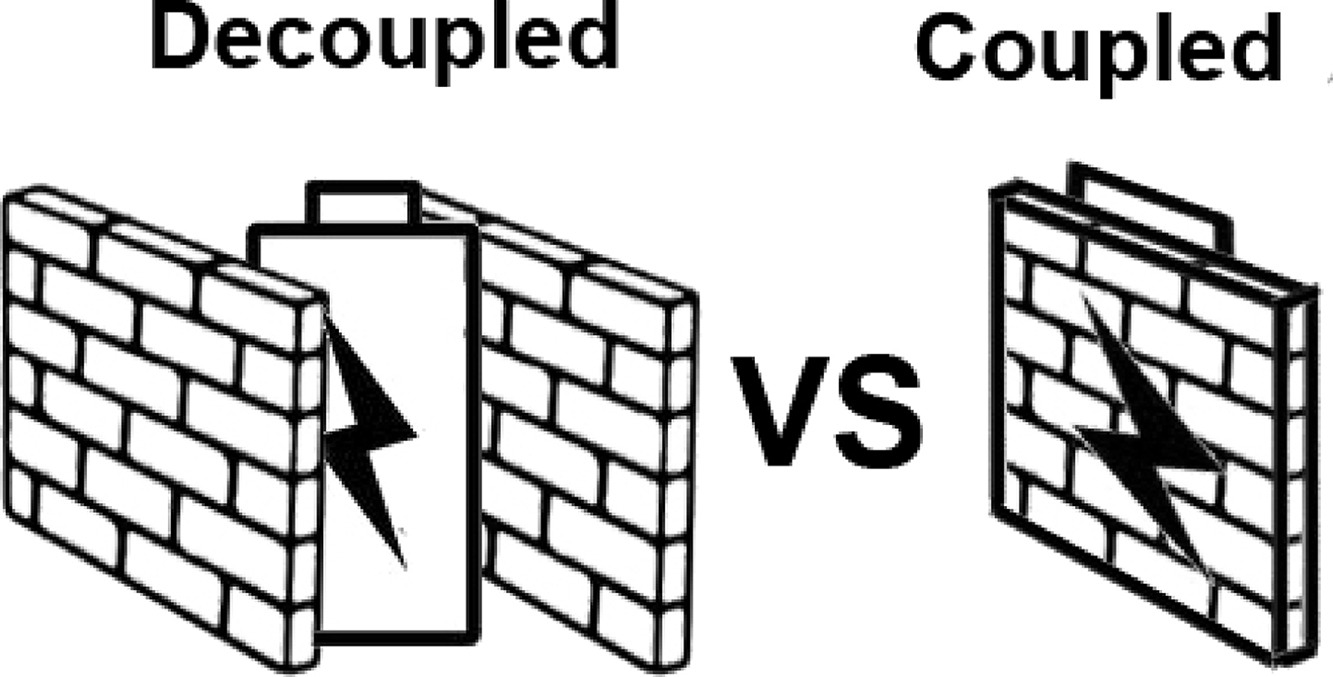
Decoupled Designs (Multifunctional Structures)
In the decoupled approach, the structural framework is divided into distinct components, each serving its own purpose. The electrochemical component is responsible for energy storage, while the mechanical bearing or structural component carries the loads.
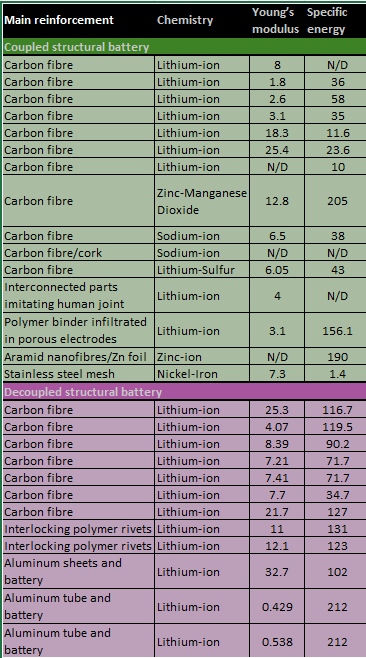
This multifunctional system involves embedding a battery within composite laminates or sandwich panels, utilizing materials such as carbon fibre (CF), honeycombs or sandwich panels that provide stiffness and strength to function as a standalone structure. Existing battery cells are embedded into these structural components, so that the structure carries the load, while the cells store energy. This method is easier to implement with current technology.
Coupled Designs (Multifunctional Materials)
In these more futuristic concepts, the battery’s own components (electrodes, electrolytes) are engineered to be strong enough to bear loads themselves. Functions are integrated at the material level. For example, the active material may be coated onto carbon fibre, allowing it to simultaneously store energy and provide load support. The matrix material itself can serve as both an electrolyte and a structural binder for the fibres. Consequently, the electrochemical component not only enables energy storage but also contributes to the load-bearing capabilities of the structure. This integration allows the electrochemical component to seamlessly merge with structural component or even function as the structural component itself, providing the necessary rigidity to fulfil structural requirements. Most of these components may lack the stiffness required to function as independent structures, unlike decoupled SBs.
Polymer moulding techniques, such as injection moulding, enable the integration of multiple parts into a single unit, reducing assembly weight and simplifying the structure. Structural adhesives can replace heavy mechanical fasteners like screws and bolts to join battery cells, reducing weight and allowing for thinner-gauge metal usage. Specialized polymers like PEEK and PTFE are utilized in peripheral battery systems (connectors, brackets, and coolant pipes) to minimize mass.
Early developments
Several major car manufacturers are already using or developing these technologies:
Tesla: Uses a “Cell-to-Chassis” (CTC) approach where the battery pack itself serves as a structural element connecting the front and rear of the car, improving rigidity and reducing weight by 10%. The technology integrates battery cells directly into the vehicle’s structural frame rather than using traditional packs/modules. Applied in Texas-made Model Ys, it uses 4680 cells and cast parts to reduce weight by around 10%, increase range by c.14%, eliminates 370 parts and lowers production costs.
BMW: BMW’s 6th Generation (Gen6) battery, debuting for the Neue Klasse vehicles, is a massive overhaul featuring 800V cylindrical cells that increase range by up to 30% and enable 400 kW charging. These “cell-to-pack” batteries, using 46mm diameter cells, offer up to 500 miles of WLTP range (approx. 300 miles in 10 mins). The battery acts as part of the vehicle structure (cell-to-pack / “pack-to-open-body”), reducing weight and increasing efficiency.
Volvo: By using structural panels (eg roof, doors, hood) as energy storage, the need for heavy battery packs is reduced, potentially cutting total vehicle weight by more than 15%. Volvo has explored replacing conventional electric car batteries with structural supercapacitors made from carbon fibre, aiming to reduce weight by over 15%. These energy-storing materials, designed for body panels like the boot lid, offer faster charging and high-power density, acting as a lightweight, eco-friendly alternative to lithium-ion batteries. Volvo has partnered with Imperial College London to create a composite material that strengthens the car’s body while storing energy. Unlike chemical batteries, these supercapacitors use ion separation, allowing them to charge and discharge almost instantly. Volvo has tested this technology in an experimental Volvo S80, including a functional boot lid and plenum cover. Supercapacitors cannot hold as much total energy as chemical batteries, making them currently less suitable for long-range, solely electric operation.
BYD: Though not involving polymeric materials, BYD’s “Cell-to-Pack” (CTP) technology, or Blade Batteries, are arranged to serve as part of the vehicle’s chassis. CTP uses lithium iron-phosphate (LFP) as the cathode material, which offers a much higher level of safety than conventional lithium-ion batteries. LFP naturally has excellent thermal stability and is substantially cobalt free. LFP is also a very durable material.
Current challenges
Structural batteries have demonstrated their potential to enhance the performance of electric vehicles, offering a multitude of possibilities. But despite this, structural batteries face hurdles before widespread adoption:
Lower Energy Density: Current prototypes often have lower energy density (around 24–30 Wh/kg) than conventional lithium-ion batteries (over 200 Wh/kg), though the overall weight savings of the car can compensate for this.
Safety: Integrating energy storage into exterior body panels presents potential safety challenges during accidents.
Production Costs: Initial development and production costs for advanced carbon fiber composites and nanomaterials are currently high.
Structural Integrity: Charging and discharging cause batteries to swell, which, over time, can stress the vehicle’s structure.
Repair and Recycling: If the battery is built into the car’s frame, it may be much harder and more expensive to repair or replace than a traditional battery pack.
References
(1) Polymers for Electric Vehicles (EV) (30 March 2022)
https://www.ulprospector.com/knowledge/12939/pe-polymers-for-electric-vehicles-ev/
(2) Polymers in Electric Vehicles (13 March 2024)
https://www.ulprospector.com/knowledge/16830/pe-polymers-in-electric-vehicles/
(3) Coupled and decoupled structural batteries: A comparative analysis
https://www.sciencedirect.com/science/article/pii/S0378775324003434

The views, opinions and technical analyses presented here are those of the author or advertiser, and are not necessarily those of ULProspector.com or UL Solutions. The appearance of this content in the UL Prospector Knowledge Center does not constitute an endorsement by UL Solutions or its affiliates.
All content is subject to copyright and may not be reproduced without prior authorization from UL Solutions or the content author.
The content has been made available for informational and educational purposes only. While the editors of this site may verify the accuracy of its content from time to time, we assume no responsibility for errors made by the author, editorial staff or any other contributor.
UL Solutions does not make any representations or warranties with respect to the accuracy, applicability, fitness or completeness of the content. UL Solutions does not warrant the performance, effectiveness or applicability of sites listed or linked to in any content.
