

 When I began researching this article, I had no idea that coil coating was invented nearly a hundred years ago. In 1930s Riverside California, Joseph Hunter invented a new system for coating the long thin strips of metal used to make Venetian blinds. Hunter was well known in Riverside as an innovative machinist who revolutionized aluminum fabrication. His technique intended to simplify window blind manufacturing led to an industry projected to have a global value of over 40 billion dollars by 2035. The successors to Hunters blind manufacturing and engineering companies are still involved in the coil coating industries.
The adoption of coil coating began in earnest in the 1950’s and today it is utilized in diverse markets from food and beverage packaging to roofing and high-rise building construction. A great advantage of coil coatings is the controlled conditions of the coil coating line. Consistent application and curing schedules can be tailored to the specific requirements of different chemistries. Many different polymer backbones make coil coatings adaptable. Film properties including flexibility, hardness, chemical, mar, and weathering resistance can be adjusted to meet the end users’ expectations. Coil coatings are not a fit for every finishing application, but they really shine in the right ones.
Coil Coating Basics
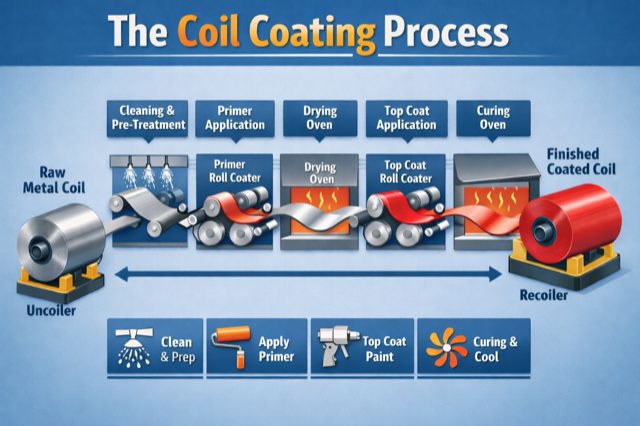
The basic concepts behind coil coating are simple, take a roll of thin sheet metal, unroll it, clean and paint it, and roll it back up. The resulting pre-painted metal can then be cut, stamped, rolled, drawn, folded, and/or welded into whatever shape the user desires. As they say, the devil is in the details. The details are where coil coating becomes diverse, inventive and complicated. Some of the attributes that make coil coating a unique solution to metal coatings needs are.
- High-speed (up to 700 feet per minute) continuous application enables high production rates.
- High temperature, short dwell time cure cycles needed for high-speed application and high throughput.
- Post-coating fabrication enables end-use application versatility but requires specialized film properties such as flexibility and mar resistance.
Polymers Utilized in Coil Coatings
A wide range of polymer technologies may be used as the primary binders in coil coatings. The first requirement is the ability to form a film and/or cross-link during the short, high temperature curing cycle used in coil coating. The film formed must be flexible and mar resistant to allow the metal to be coiled back up for transport and to allow post coating forming into the final shape. The polymer must also be able to withstand any environmental conditions to which the final product is exposed. Since these conditions can vary widely and include exposure to sunlight, corrosive environments, high humidity, and household or industrial chemicals, the polymers used in pre-painted metal can include any of the following to achieve the expected performance.
- Exterior Applications – resins are shown below listed in increasing levels of performance and price. The highest performance and cost levels might be guaranteed for up to twenty years against fading and chalking.
- Acrylic and/or Polyester
- Super Durable Silicone Modified Polyesters
- Silicone
- Fluoropolymer, often combined with acrylic resins
- Interior, Backer and Primer Applications – have performance demands ranging from moderate environmental conditions to very humid or corrosive conditions, and chemical contact, but without exposure to sunlight.
- Acrylic
- Polyester
- Epoxy
The polymers used in coil coating may cure by myriad mechanisms. Fluoropolymer based coatings are usually thermoplastic solution polymers such as Polyvinylidene fluoride which cure by solvent evaporation. Other coil coating systems depend on cross-linkers to form durable films. Workhorse crosslinkers such as modified melamine formaldehyde resins and blocked isocyanates are stable at storage and application temperatures but react under the high temperatures of typical coil line curing ovens to form durable yet flexible films.
Important Markets
What markets can best take advantage of coil coatings unique attributes? The list is long and some of the products might be quite surprising. Anything that can be made of sheet metal can be coil coated. One of the widest uses of coil coated metals is for the fabrication of building products. Other industries which take advantage of coil coatings are appliances, furniture, HVAC equipment, and food and beverage packaging.
Building products are often made from precoated metal. The wide variety of chemistries available for coil coating lends itself to many exterior and interior applications. Silicone modified and Fluoropolymers are used in applications requiring long-term exposure to sunlight and moisture.
- Roofing – cool roofing with Heat Reflective Pigments
- Exterior walls – commercial, industrial, agricultural, aviation structures and less common than in the past, aluminum siding
- Personnel Entry and vehicle doors
- Components such as gutters and trim
- Window frames
- Curtain wall supports for high rise construction
Appliances, Furniture and White Goods may not be as demanding applications as exterior building products but the variety of chemistries available to formulate coil coatings still proves useful to maximize the balance of performance and price. Coil coating enables more efficient and lower cost manufacturing of these commercial and consumer goods by eliminating painting after assembly.
- Ranges, refrigerators, freezers, and microwaves
- HVAC cabinets and ductwork
- Outdoor furniture
- Electrical enclosures
Food and Beverage Packaging applications demand specialized polymer binders to ensure product safety and protect quality. One of the most recent advances in polymer chemistry relating to coil coatings is the development of Bisphenol A free container linings for products ranging from canned peas to beer. Coil coating lines are often integrated into plants which also fabricate containers and fill them with food or beverages all at one site.
- Container Linings – preserve quality and taste of contents
- Overprint Coatings – protect the labels and package appearance in shipping
Sustainability Advantages of Coil Coatings
Coil coatings facilitate sustainability in so many ways it’s hard to name them all in one paragraph. The automated nature of coil coating application methods yields a very high transfer rate of coating to the substrate. This enables very efficient use of the coating materials. The enclosed application and curing process allows collection of Volatile Organic Compounds (VOC) which can be consumed in Regenerative Thermal Oxidizers (RTOs) where the generated heat is used in the curing process. Long term durability inherently enhances sustainability by reducing the need for maintenance or replacement of manufactured goods. Specialized heat reflective coil coatings can be used on building roofs and exterior walls to reduce energy demand and mitigate Urban Heat Island Effect.
ULTRUS™ Product Stewardship enables material selection, compliance, sustainability and chemical management throughout the product life cycle to meet regulatory requirements and consumer demands. Learn more here!
Future Developments in Coil Coatings – Increasing Sustainability
Even though coil coatings have many positive sustainability attributes, there is room for improvement. Coil coating lines consume a lot of energy. Most high temperature curing ovens are gas fired, generating large carbon footprints from CO2 generation. Using RTOs can reduce VOC emissions and capture the fuel value of coating volatiles, but the process still generates CO2 and contributes to overall carbon footprint. If a coil coating line is located near other CO2 generators it might be practical to use Carbon Capture Utilization (CCU) technology to covert waste CO2 to useful raw materials such as methanol. Some other avenues of research aiming to improve the sustainability of coil coatings include.
- Lower cure temperatures or hybrid curing – such as a combination UV/Thermal dual curing mechanism
- Lower VOC – 100% solids, higher solids, or waterborne coatings for less solvent emissions
- Powder coatings – could be a game changer, but curing schedules and film thickness control issues must be overcome
- Enhanced NIR Reflectivity – cool roof and wall applications for higher energy efficiency and reduced Urban Heat Island Effects
- Self-Healing – durability promotes longevity and cradle to grave life extension
- Upstream and downstream integration of coil coating with other manufacturing – reduced transportation yields a lower carbon footprint
What started as a better way to make Venetian Blinds has expanded into a game changing way to finish metal used in myriad applications. The future of coil coatings certainly holds the prospect of expanding applications and an increasing share of the industrial coatings market. Through continued research and development, coil coatings are becoming more durable, easier to process and more sustainable alternatives to other metal finishing methods.

The views, opinions and technical analyses presented here are those of the author or advertiser, and are not necessarily those of ULProspector.com or UL Solutions. The appearance of this content in the UL Prospector Knowledge Center does not constitute an endorsement by UL Solutions or its affiliates.
All content is subject to copyright and may not be reproduced without prior authorization from UL Solutions or the content author.
The content has been made available for informational and educational purposes only. While the editors of this site may verify the accuracy of its content from time to time, we assume no responsibility for errors made by the author, editorial staff or any other contributor.
UL Solutions does not make any representations or warranties with respect to the accuracy, applicability, fitness or completeness of the content. UL Solutions does not warrant the performance, effectiveness or applicability of sites listed or linked to in any content.