

Resin manufacturers today are striving to boost the recycled content in their materials while continuing to meet their customers’ stringent performance demands. Doing so helps those product makers to lower their carbon footprint and improve their environmental profile while converting some waste plastics into a valuable resource.
These efforts take many forms. Here are two very different examples.
Nova’s Recycled PE Film Goes Full Circle
Calgary, Alberta-based Nova Chemicals Corp. reported recently that Sigma Plastics Group had placed the very first order for Nova’s Syndigo™ rPE-IN3 recycled polyethylene (rPE) –– a railcar shipment totaling nearly 200,000 pounds. Sigma will use the non-food-contact material in its Shelbyville, Ky., plant, to make stretch film products.
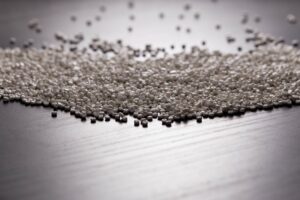
Just over a year ago, Nova commissioned its first polyethylene film recycling facility, dubbed Syndigo1, in Connersville, Ind. It called the facility “one of the largest and most sophisticated plastic film mechanical recycling facilities in the world.”
Syndigo1 spans 450,000 square feet and will recycle 145,000 bales of end-of-life plastic film to produce more than 100 million pounds of Syndigo™ recycled rPE resin annually. The facility ramped up to full production earlier this year. For context, Nova notes, that’s 9.7 million cubic feet of film collected and diverted from landfills each year. That’s enough to fill four professional football fields to the top of the goal posts.
Nova makes its Syndigo portfolio of resins from 100 percent post-consumer recycled (PCR) films. It plans to further extend this product range later this year by rolling out rPE-IN1 and rPE-IN2 versions, both of which are LLDPE resins targeting flexible food packaging. Its mechanical recycling process has received a letter of non-objection (LNO) from the U.S. Food and Drug Administration, confirming that the rLLDPE made using this process is suitable for food-contact applications.
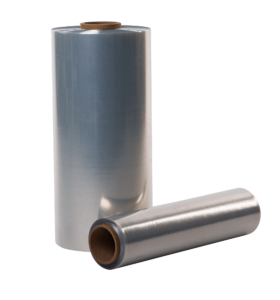
Nova said that Sigma will incorporate its Syndigo rPE-IN3 resin into stretch films that it will sell to retailers and distribution centers. While not specifying the percentage of recycled content, Sigma will use the material in products such as its Sustain360 PCR stretch film line, which includes hand films for manual application and high-performance machine films used for palletized load containment in retail distribution centers, warehouses, and logistics operations.
“Achieving ‘like-to-like’ recycling, where stretch film is recycled and turned back into stretch film, is a significant advancement for mechanically recycled polyethylene,” said Anna Rajkovic, Nova’s market and innovation manager for mechanical recycling.
Syensqo HPPA Resin Used in Woom’s WOW Bikes
In a starkly different application, Brussels-based Syensqo has formed a partnership with woom, an Austrian maker of bikes for young children and teens. The deal calls for woom to use Syensqo’s Omnix® 1030 ECHO RPRF circular polymer in its new WOW series of bikes. The material, a 30 percent glass fiber-reinforced, high-performance polyamide (HPPA), contains 98 percent recycled content.
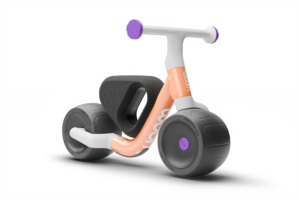
Used in key visible structural components, including the front fork, back fork, and handlebars of woom’s latest models, the resin “can reduce the product’s carbon footprint by up to 72 percent compared to conventional materials, while still delivering the strength, durability, and quality needed for everyday use,” according to Syensqo, which spun out of Solvay Group in late 2023.
Discover Material Selection with Prospector Premium, learn more here!
Woom says it designed its WOW self-balancing bike for children aged 9 to 36 months. It aims to help them develop balance and motor skills through an intuitive, stabilizing design. Made in Europe, it combines a lightweight, premium look with more sustainable materials, including this HPPA resin from Syensqo. The material is being used in components previously made out of metal or virgin engineered plastics.

Woom was founded in 2013 in a garage in Vienna, Austria, by Marcus Ihlenfeld and Christian Bezdeka –– both of whom were fathers and bike enthusiasts. Christian, a trained biomedical technician with a degree in industrial design and years of experience in the bike industry, and Marcus, who up to that point had been a marketing manager within the automotive industry, founded woom.
The companies said they will continue to collaborate on data generation, simulation, and technical development to further expand the use of recycled polymers in future bike and e-bike applications.
Florian Stattmann, woom’s director of product management and commercialization, described the new WOW product line as “a breakthrough innovation in children’s mobility, developed in close collaboration with pediatric experts and featuring intuitive self-centering steering alongside a truly child-centric ergonomic design.”

The views, opinions and technical analyses presented here are those of the author or advertiser, and are not necessarily those of ULProspector.com or UL Solutions. The appearance of this content in the UL Prospector Knowledge Center does not constitute an endorsement by UL Solutions or its affiliates.
All content is subject to copyright and may not be reproduced without prior authorization from UL Solutions or the content author.
The content has been made available for informational and educational purposes only. While the editors of this site may verify the accuracy of its content from time to time, we assume no responsibility for errors made by the author, editorial staff or any other contributor.
UL Solutions does not make any representations or warranties with respect to the accuracy, applicability, fitness or completeness of the content. UL Solutions does not warrant the performance, effectiveness or applicability of sites listed or linked to in any content.