

 Pigment concentrates play a valuable role in coatings formulations for all applications. From Point-of-Sale colorants that allow thousands of color choices at your neighborhood paint store, to industrial pigment dispersions used to precisely and efficiently match factory-applied coatings. Each pigment concentrate is a formulation in and of itself that goes through the same development process as the paint formulas they are a component of. No matter the end use, one of the best ways to improve the performance and utility of a pigment concentrate is to increase the volume of pigment in the formulation. Let’s explore High Pigment Volume Concentrates, why they are, what are their advantages, and what components they contain.
The definition of a high pigment volume concentrate is situational. It depends on the application as well as the established pigment volume concentration of similar products in common use. If the pigment dispersions in common use for a deep red architectural coating have a pigment volume concentration of 25%, then a concentrate at 50% would be considered a high pigment volume concentrate. In an established industrial coatings pigment dispersion used for in-plant tinting, the pigment volume concentration for the same pigment might be much higher. In short, a high pigment volume concentrate has a higher pigment volume concentration than the commonly used colorants for that application. The goal is to achieve the highest practical pigment volume percentage for the intended end-use.
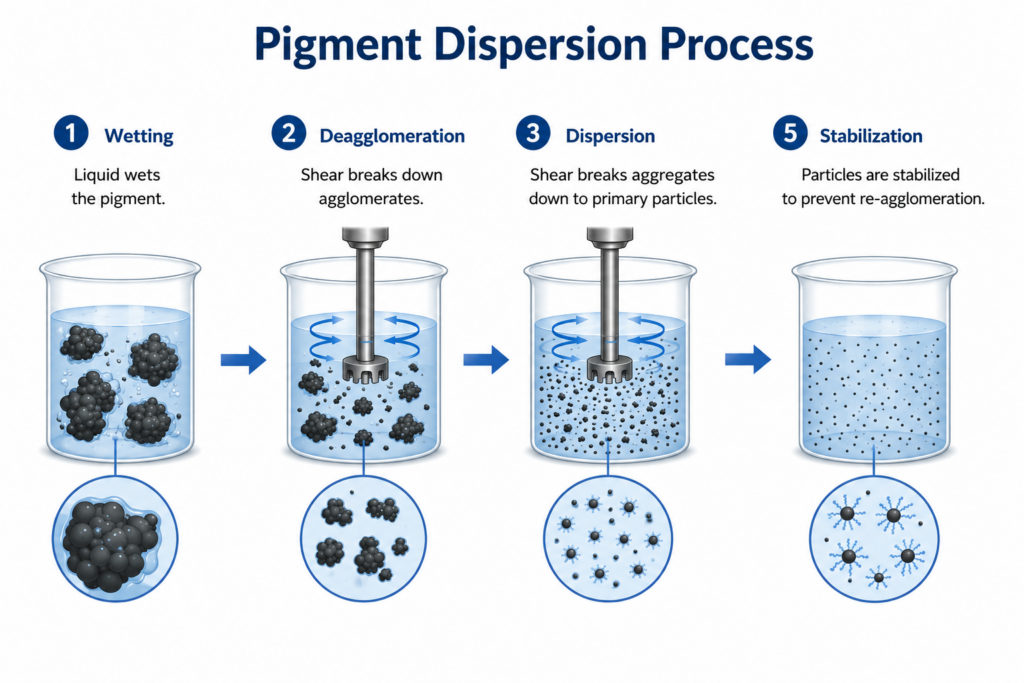
Let’s explore the basics of the pigment dispersion and stabilization process. Dry pigments are sold as powders, which are aggregates of smaller primary particles. These primary particles are the smallest unit of pigment size and will vary with the type and grade of the pigment. In the pigment dispersion process, the goal is to break down aggregates into the primary particles and stabilize them to prevent re-agglomeration. Mechanical shear force is used to separate the agglomerates into primary particles. Dispersing agents are used to wet the agglomerates, helping to separate them, allowing the mechanical forces to break them up. Stabilizing agents keep the primary particles apart. Choosing the most effective dispersing and stabilizing agents is a vital part of developing high pigment volume concentrates.
What are the drivers for the adoption of high pigment volume concentrates? Each application has different reasons to use these materials, but there are compelling justifications for them in a wide range of markets. High pigment volume concentrates reduce shipping and storage costs while allowing flexible tinting into different paint bases. In architectural coatings, these colorants can achieve a wide range of color selections with fewer paint bases and help reduce undesired effects like viscosity drop and film softening in deep shades. In automotive and industrial coatings, they can increase opacity in high chroma colors and reduce the number of pigment grinds needed to match colors.
In order to successfully formulate pigment dispersions with high pigment volumes, hurdles common to all end uses must be overcome. Pigment dispersions’ viscosities need to be low enough to allow easy dispensing. High pigment volume concentrations make this more difficult. The proper viscosity range is dependent on multiple factors, including dispensing method, storage conditions, the pigment in the dispersion, the viscosity of the paint base, and how the colorant and base are mixed. Attaining the required rheological profile to satisfy all these needs is the most important part of formulating high pigment volume concentrates.
Shelf-life or storage stability is an important property for pigment dispersions, and viscosity is one of many important factors affecting storage stability. There are other properties that are vital to extending shelf-life and maintaining the quality of pigment concentrates. Pigment settling is a common problem in pigment dispersions and negatively affects shelf-life. At best, pigment settling is a nuisance requiring shaking or mixing of the dispersion; at worst, it can lead to unusable material, incurring replacement and disposal costs. Other indications of poor storage stability are changes in viscosity and tint strength. Changes in either of these properties lead to errors in delivering the proper color strength dispersion to the paint base and mismatched colors.
Sustainability reporting is here to stay. Is your organization ready? Learn more here!
Components of High Pigment Volume Concentrates
How are the important properties of high pigment volume concentrates affected by their components? The most influential component is the pigment. Pigments are classified by Pigment Index number or PI for short. This specifies the chemical identity of the pigment but not properties like particle size, size distribution, or surface treatment. General inferences about pigment dispersibility and stability can be drawn from the PI number, but most dispersion properties will vary from one commercial grade to another due to differences in finishing after the pigments are synthesized. Choosing the proper commercial grade of your pigment can be a large determining factor in how the final properties of the dispersion, including the maximum pigment volume concentration, are affected.
Dispersants are the second most critical component when formulating a pigment dispersion. The rheological profile, tint strength, stability, and compatibility with paint bases are all influenced by the choice of dispersant in the formulation. Coatings additives suppliers are developing innovative pigment dispersants to meet the needs of high pigment volume concentrates. These include products like Dispex® Ultra PX 4575 from BASF, which is tailored to achieve highly concentrated dispersions of inorganic pigments such as transparent red oxides with low viscosity, high tint strength, and enhanced stability. Optimizing the dispersant for your pigment and application is critical to making sure your pigment dispersion meets your and your customers’ expectations.
Other additives besides dispersants influence colorant properties such as viscosity and shelf-life. Biocides are important to preserve waterborne colorants against microbial contamination, especially in point-of-sale applications like architectural coatings. Thermal and oxidative stabilizers also protect against degradation of the pigment dispersion. Low shear rheology modifiers such as modified bentonites are especially useful at preventing hard settling of dense pigments like mixed metal oxides. While not usually considered additives, solvents or diluents can affect colorant properties as well. Solvents, including water, help lower viscosity and can be used to adjust total solids of the formulation. Low molecular weight monomers and oligomers help adjust viscosity in UV cured coatings without adding VOC content.
What the Future Holds
Future developments in high pigment volume concentrates are driven by three goals: enhanced sustainability, lower costs, and improved performance. Ways to improve the sustainability of pigment concentrations include:
- Lower or zero VOC dispersions, which enable driving down the VOC content of paints.
- Volume dispensed dry powder pigment dispersions reduce VOC and shipping costs and aren’t susceptible to microbial contamination since they don’t contain water.
- Dispersions which are free of biocides and chemicals of concern like PFAS will make colorants safer to use in POS environments and paints safer for consumers and contractors alike.
Lower cost and enhanced performance go hand in hand to broaden the adoption of high pigment volume concentrates in the coatings industry.
- Colorants with higher opacity and color/tint strength can improve coating performance by reducing the negative effects that can be caused by using high levels of pigment dispersions. They also offer the best cost-in-use value proposition for the coatings’ maker.
- Pigment dispersions with broad compatibility in a range of coatings systems like urethane, epoxy, alkyd, and waterborne acrylic reduce a paint manufacturer’s colorant inventory. This saves material storage space and lowers the cost of carrying several dispersions of the same pigment for multiple product lines.
In Summary
Learning about high pigment volume concentrates isn’t just important for formulators making their own dispersions. Paint formulators who use them as ingredients also need to know what advantages they offer as well as their possible limitations. This article can only skim the surface of this complicated subject. I encourage you to use all the resources available on the subject, including colorant suppliers and materials databases, to learn more. Like other areas of coatings formulation and raw materials, I believe that AI techniques will be used to advance the state of high pigment volume concentrates at an accelerated pace, making the future even more colorful.

The views, opinions and technical analyses presented here are those of the author or advertiser, and are not necessarily those of ULProspector.com or UL Solutions. The appearance of this content in the UL Prospector Knowledge Center does not constitute an endorsement by UL Solutions or its affiliates.
All content is subject to copyright and may not be reproduced without prior authorization from UL Solutions or the content author.
The content has been made available for informational and educational purposes only. While the editors of this site may verify the accuracy of its content from time to time, we assume no responsibility for errors made by the author, editorial staff or any other contributor.
UL Solutions does not make any representations or warranties with respect to the accuracy, applicability, fitness or completeness of the content. UL Solutions does not warrant the performance, effectiveness or applicability of sites listed or linked to in any content.