

Hydrophobic coatings if formulated correctly can provide a plethora of advantages which may include self-cleaning, corrosion resistance, and exterior durability.
Most industrial, marine and exterior applications, require a coating to do more than repel water as determined by contact angle. The coating needs to continue to perform after it is subjected to abrasion, condensation, salt exposure, cleaning, handling, and exposure to the elements. Whether it does so depend on the full coating design: surface chemistry, particle treatment, dispersion quality, binder composition, compatibility, and the way the coating system is built.
Hydrophobic coatings are commonly discussed in terms of surface energy, contact angle, and the lotus effect. Those concepts remain useful, particularly during early formulation work. But a high contact angle alone does not tell a formulator whether moisture can move through the film, whether adhesion will survive wet exposure, or whether the water-repellent effect will remain after the surface is worn.
The practical question is therefore not simply, “How high is the contact angle?” A better question is: “How much useful hydrophobic performance remains in service?”
This article builds on previous UL Prospector discussions of hydrophobic pigment wetting and dispersion, hydrophobic coating fundamentals, surface engineering, and volume hydrophobicity. Here, the focus is on applying those principles to coatings that must retain their performance after exposure and wear.
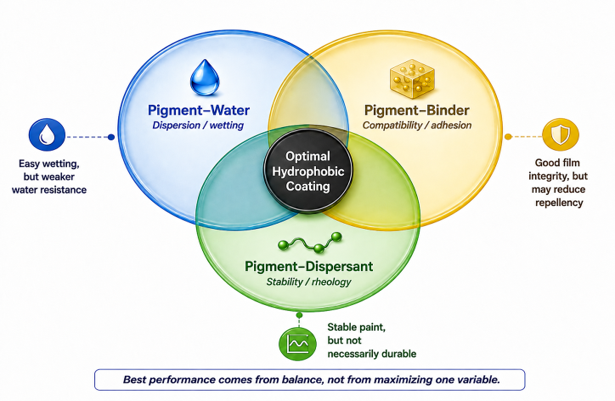
Hydrophobicity Is a System Property
Formulators face an immediate tradeoff. A pigment or filler that strongly rejects water after cure can be difficult to wet and disperse during paint manufacture. If a pigment’s surface tension is very low, the result can be slow grind development, agglomeration, flooding and floating, viscosity drift, or weak interaction with the binder.
The opposite tradeoff also applies. Modifying a particle for easier processing can reduce the water-repellent benefit expected in the cured film. In practice, success requires a balance among pigment wetting during manufacture, dispersant stabilization, and compatibility with the cured binder.
These factors cannot be evaluated independently. A dispersion may be stable in the container yet provide limited durability if the particle is not well integrated into the cured network. Similarly, a highly hydrophobic particle may not be practical for a particular formulation or process if it cannot be dispersed uniformly.
Where the Hydrophobic Chemistry Resides
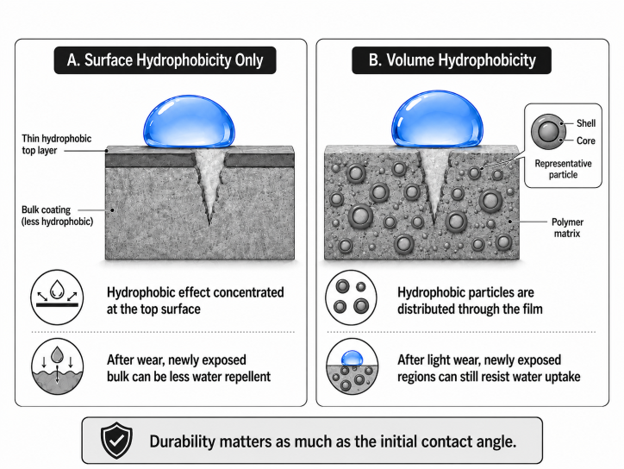
Water repellency can be created in more than one way. One approach concentrates low-surface-energy chemistry near the outer surface of the coating. Silicones and siloxanes are common examples. They can reduce water affinity and produce strong initial beading.
Another approach distributes hydrophobic functionality through the film, using resin design, treated particles, or both. This can be useful when abrasion or long-term barrier performance matters, because material exposed after minor surface wear may still contribute to water resistance.
An epoxy floor coating over concrete illustrates why the choice is application-dependent. A PDMS-type modifier may lower surface energy and improve water release, but excessive migration can complicate recoating or intercoat adhesion. An organofunctional alkoxysilane may couple to hydroxylated mineral surfaces while also interacting with the organic network. For this application, wet adhesion, abrasion retention, water release, cleanability, traction, and recoatability provide a more useful basis for selection than contact angle alone.
U.S. Patent 10,982,112 B2 describes a reactive hydrophobic silicone coating for substrates including metal, plastic, and glass. US 2022/0135834 A1 describes a two-part hydrophobic polyurethane coating architecture for corrosion-resistant service. Although the chemistries differ, both illustrate the same formulation principle: durable repellency depends on how low-surface-energy functionality is incorporated into the coating, rather than on simply adding a hydrophobic ingredient.
From Surface Beading to Barrier Performance
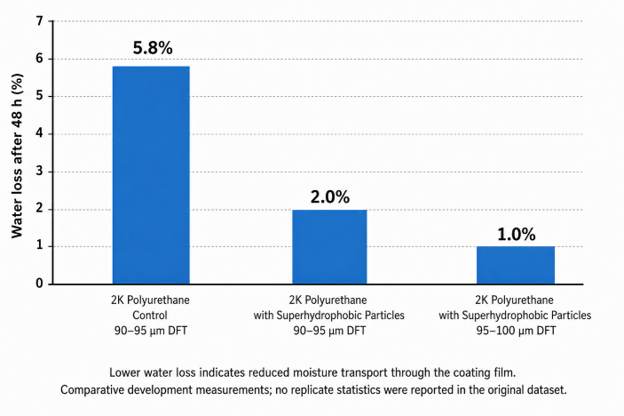
Water beading is commonly the first observation in a hydrophobic-coating program. For protective coatings, it should be followed by measurements that address water transport through the film and the effect of moisture on adhesion and corrosion resistance.
In one internal polyurethane formulation screen, increasing hydrophobic particle functionality was associated with lower values in the program’s water-transport screening measurement. The result suggested that the formulation change was affecting more than the behavior of water on the outer surface. Because this was an unpublished internal comparison, the test method, film thickness, exposure conditions, replication, and rating criteria should be reported with the data before publication.
This is a useful way to think about volume hydrophobicity. The term does not mean every point in a coating has the same contact angle. It describes a coating architecture that continues to resist water interaction beneath the outermost surface, so minor abrasion does not necessarily remove the entire hydrophobic contribution.
Corrosion Testing Shows Whether the System Works
Long-duration corrosion testing can reveal whether hydrophobicity is contributing to protection of the substrate. In an internal salt-spray comparison, the most favorable result within the evaluated formulation set was reported when hydrophobic particle functionality was included in both primer and topcoat. A topcoat-focused configuration showed greater corrosion at the scribe under that program.
These observations should be presented as formulation-specific internal results, not as a general performance guarantee. Before publication, the article should identify the test standard, exposure duration, panel preparation, scribe method, replicate count, and rating criteria. If ASTM B117 was used, it should be named directly as a salt-spray test.
ULTRUS® software solutions connect product life cycle data, regulatory content and expertise and AI-driven automation and analytics. Learn more here!
A separate internal validation program reportedly completed extended salt-spray exposure without rust, blistering, or adhesion loss under its stated criteria. The duration, test method, and assessment criteria should be documented in the supporting report. These separate programs should not be presented as one controlled comparative series.
The broader conclusion is sound: demanding protective systems rely on more than surface beading. Strong substrate adhesion and reduced water and electrolyte transport work together to improve corrosion resistance.
| Architecture evaluated | Appropriate interpretation |
| Hydrophobic functionality in primer and topcoat | Internal result; described as the most favorable result within the evaluated formulation set. |
| Hydrophobic functionality concentrated in topcoat | Internal result; report the corrosion rating, scribe condition, and test method rather than using a broad qualitative claim. |
| Separate optimized primer/topcoat validation | Report only with complete test duration, standard, panel preparation, and rating criteria. |
Table 1. Influence of Hydrophobic Particle Placement on Corrosion Performance
High Contact Angle Does Not Guarantee Water Shedding
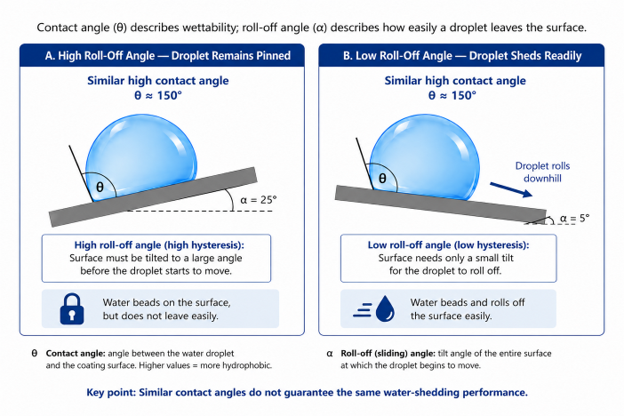
Contact angle is useful for screening, but it does not tell the whole story. Two coatings can produce similar contact-angle readings and still handle water very differently. On one surface, a droplet may roll away with only a slight tilt. On another, it may stay in place.
That difference is important for self-cleaning surfaces, optical covers, sensor covers, and radomes. In these applications, water needs to move off the surface quickly. Roll-off or sliding angle provides a practical way to evaluate that behavior. Contact-angle hysteresis can also help explain why droplets stay pinned.
Shi et al. reported a waterborne polyurethane coating with HDTMS-modified SiO₂ nanoparticles that achieved a 156.6 ± 0.5° water contact angle and a 3.2° sliding angle. The coating also retained superhydrophobic behavior after abrasion testing.
Chemical Dynamics has developed a hydrophobic coating for sensor-protection radome applications with a roll-off angle below 5°. The low roll-off angle helps droplets release from the surface at a slight tilt, which is important where standing water or surface contamination can affect sensor-cover performance.
| Application | Primary performance need | Useful proof points |
| Industrial steel and infrastructure | Limit water and salt exposure at the metal surface | Moisture transport, wet adhesion, salt or cyclic corrosion |
| Transportation, aerospace, and defense | Shed water while resisting fluids, cold, wear, and impact | Roll-off, retained contact angle, fluid resistance, impact, corrosion |
| LiDAR, sensors, and radomes | Remove droplets and contamination without impairing function | Low roll-off, cleanability, functional compatibility, abrasion, weathering |
| Floors and concrete protection | Repel water while preserving adhesion, traction, and recoatability | Wet adhesion, abrasion retention, roll-off, cleanability, recoatability |
Table 2. Hydrophobic Coating Applications, Performance Needs, and Validation Methods
Test for the Actual Failure Mode
Hydrophobic-coating programs are most efficient when testing is tied to the expected service failure. Contact angle establishes whether water readily wets a surface. ASTM D7334 is a practice for measuring advancing contact angle to characterize surface wettability of coatings, substrates, and pigments; it does not specify sliding or roll-off angle.
Roll-off and sliding-angle measurements address water shedding. Moisture-permeation or water-vapor-transport testing can help assess barrier performance through a film. Abrasion followed by repeat wettability measurements indicates whether the effect survives wear. Wet adhesion, salt or cyclic corrosion, condensation exposure, and electrochemical impedance spectroscopy (EIS) can be selected when the objective is substrate protection.
| Development question | Measurement that helps answer it |
| Does water avoid wetting the surface? | Advancing water contact angle; ASTM D7334 where applicable |
| Does water leave easily? | Sliding or roll-off angle; contact-angle hysteresis when needed |
| Does the film slow water transport? | A validated moisture-permeation or water-vapor transmission method |
| Does repellency survive wear? | Abrasion followed by repeat contact-angle and roll-off measurements |
| Does the system protect the substrate? | Wet adhesion plus salt, cyclic-corrosion, condensation, or EIS testing as appropriate |
Table 3: Hydrophobic Coating Testing and Performance Validation
Evaluate Beyond the Initial Water Bead
A water bead on a freshly coated panel is a useful first check, not proof of long-term performance. A coating that appears highly hydrophobic when new may lose repellency after abrasion, permit moisture transport, or experience adhesion loss during extended wet exposure.
The appropriate design depends on the service requirement. A sensor coating may prioritize rapid droplet release. An industrial primer/topcoat system may benefit more from reducing water and electrolyte transport while preserving wet adhesion. In both cases, the goal is to build hydrophobic function into the coating architecture so that it remains useful after the surface is no longer pristine.
Formulator Takeaways
- Use contact angle as an early screening measurement; add roll-off testing when water shedding is important.
- Select hydrophobic particles that can be dispersed reliably during manufacture and remain well integrated into the cured binder.
- For protective coatings, evaluate water and electrolyte transport through the film rather than relying only on initial water beading.
- Place hydrophobic functionality according to the expected failure mode: surface release, through-film barrier performance, or both.
- Report internal results with the relevant method, conditions, replication, uncertainty, and rating criteria; do not combine separate programs as if they were one controlled study.
References
- Lewarchik, R. Dispersing & Wetting Hydrophobic Pigments & Fillers in Water-Based Paints to Avoid Pigment Flooding & Floating. UL Prospector Knowledge Center, 2014.
- Lewarchik, R. Hydrophobic Coatings Explained. UL Prospector Knowledge Center, 2015.
- Lewarchik, R. On the Surface: Formulating Hydrophobic Coatings for Breakthrough Performance. UL Prospector Knowledge Center, 2018.
- Lewarchik, R. Hydrophobic/Super-Hydrophobic Coatings. UL Prospector Knowledge Center, 2022.
- Lewarchik, R.; Makode, V. Direct-to-Metal Coatings: Evolving Chemistry, Elevated Performance, and Enhanced Sustainability. UL Prospector Knowledge Center, 2025.
- S. Patent 10,982,112 B2. Hydrophobic Silicone Coating. Chemical Dynamics LLC; granted April 20, 2021.
- S. Patent Application Publication US 2022/0135834 A1. Two-Part Hydrophobic Polyurethane Formulations Forming Corrosion Resistant Coating. Published May 5, 2022.
- Shi, X. et al. A durable superhydrophobic coating based on waterborne polyurethane and HDTMS-modified SiO₂. Colloids and Surfaces A, published online October 16, 2025. Confirm final bibliographic details before publication.
- ASTM D7334-08(2022), Standard Practice for Surface Wettability of Coatings, Substrates and Pigments by Advancing Contact Angle Measurement.


The views, opinions and technical analyses presented here are those of the author or advertiser, and are not necessarily those of ULProspector.com or UL Solutions. The appearance of this content in the UL Prospector Knowledge Center does not constitute an endorsement by UL Solutions or its affiliates.
All content is subject to copyright and may not be reproduced without prior authorization from UL Solutions or the content author.
The content has been made available for informational and educational purposes only. While the editors of this site may verify the accuracy of its content from time to time, we assume no responsibility for errors made by the author, editorial staff or any other contributor.
UL Solutions does not make any representations or warranties with respect to the accuracy, applicability, fitness or completeness of the content. UL Solutions does not warrant the performance, effectiveness or applicability of sites listed or linked to in any content.