

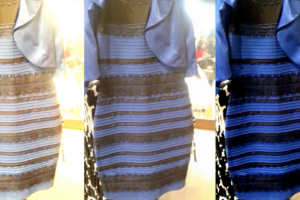
In 2015, the internet blew up with a controversy so divisive that people from Taylor Swift to a United States Senator felt they had to weigh in. What question was so important that millions of people were compelled to post on multiple social media platforms in order to have their voice heard? “Is this dress blue and black or white and gold?”
I see two very important takeaways from this viral controversy. First, different people or observers can perceive the same colors very differently. Second, people get way overexcited about things on the internet.
Many factors may contribute to variations in color perception from one observer to another. These can include illumination conditions, artificial vs. natural light sources, and patterns of shadow and reflection from the surrounding environment. How the human eye views and interprets color can change with factors such as age, nearsightedness, genetic conditions like color blindness, and fatigue. All of these variables contribute to how two people can see the same color differently. Since the 1920s, researchers have been working to quantify how people perceive color and how to standardize color measurements without using a human observer.
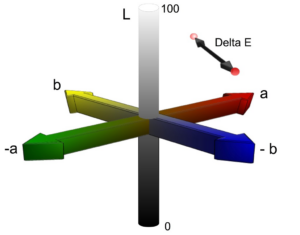 Although there are many systems in place to quantify color without human observation, the method most commonly used today is known as CIELab.
CIELab describes color as a three-dimensional space with numeric values on the three axes consisting of one lightness and two chroma, or color, components. The corresponding descriptors for these axes are:
L = lightness scale, a = green/red scale, b = yellow/blue scale
(Delta E is a way to measure color difference)
First defined in 1976 by the International Commission on Illumination (Commission Internationale de l’Éclairage abbreviated as CIE), the CIELab system encompasses the entire range of human color perception.
Quantifying Human Color Perception
If we want to quantify color, we must first define it in measurable parameters. Human color perception relies on three types of light receptors in the retina of the eye. These receptors are called short, medium, and long cones, and they respond to blue, green, and red light in that order. The first color measurement systems attempted to mimic the human eye by measuring the reflectance in each of these areas. The CIE first developed a system to quantify color in 1931 with the Tristimulus System. A key component of this system was the mathematical treatment of spectral reflectance data to model how the average human eye perceived colors.
ULTRUS® software solutions connect product life cycle data, regulatory content and expertise and AI-driven automation and analytics. Learn more here!
Instrumentation
Instruments capable of measuring spectral reflectance accurately are used to evaluate color. This data is then translated to the L, a, and b parameters of the CIELab system. In order to compare two colors on an equal footing, several measurement conditions must be the same. First, the source of illumination must be identical for the two measurements. Spectrophotometers designed to measure color have a range of standard illuminants to choose from. For example, D65 is a standard illuminant frequently used for color matches in daylight environments. Other conditions which must be specified are the angle of observation and whether or not to include specular (angular reflectance) as well as the diffuse reflectance of light from the surface in the measurements.
Math (A Necessary Evil)
Before the CIELab values for a color are determined, mathematical treatments are used to compensate for the human eye’s tendency to perceive color differences within some color spaces better than others. The broad term for these differences in color interpretation is color tolerance. There are a series of equations that describe how color tolerances are calculated which will not be discussed in this article. When it comes to higher mathematics I do not need to know how the sausage is made, I just trust the results.
Another important and much more straightforward calculation that I understand and will therefore discuss, is the calculation of color difference. Most commonly referred to as Delta E, 𝚫E, or simply DE, this number can correlate to how different two colors appear to an observer. Delta E is calculated using the equation below.
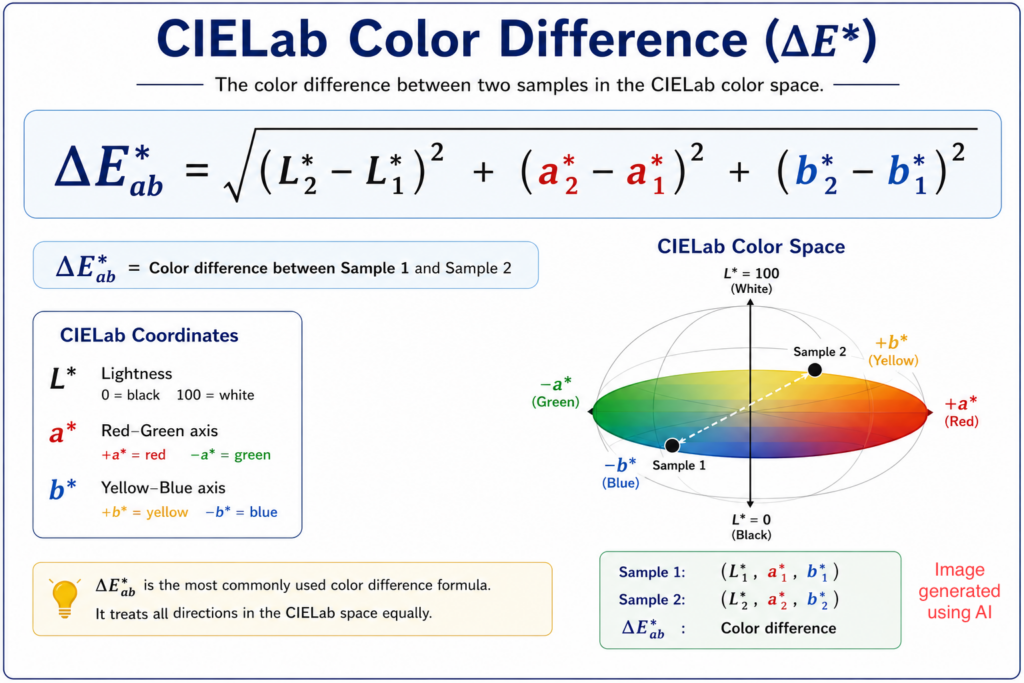
The value of 𝚫E can be a useful indicator of whether or not a human observer can distinguish between two similar colors. Care must be used when using 𝚫E as a color matching approval metric for two reasons. First, not everyone sees color the same, especially experienced color specialists. Second, end-users have different expectations of what is an acceptable color match. For example, two colors with a 𝚫E of 2 might be acceptable to an interior designer or architect but would not be to an automotive quality control manager.
CIELab as an International Standard
We have seen that CIELab is a powerful tool to describe color in terms relating to how humans perceive it and as a way to compare two colors. It can even help us estimate how well colors might match visually. Its status as an internationally accepted standard for color communication enhances CIELab’s utility. Color stakeholders all over the world can use a common language, so to speak, to describe, specify, and control color for coatings, inks, fabrics, and plastics. This ensures proper color harmony for multi-nationally sourced products, an overlooked but important part of the global economy.

The views, opinions and technical analyses presented here are those of the author or advertiser, and are not necessarily those of ULProspector.com or UL Solutions. The appearance of this content in the UL Prospector Knowledge Center does not constitute an endorsement by UL Solutions or its affiliates.
All content is subject to copyright and may not be reproduced without prior authorization from UL Solutions or the content author.
The content has been made available for informational and educational purposes only. While the editors of this site may verify the accuracy of its content from time to time, we assume no responsibility for errors made by the author, editorial staff or any other contributor.
UL Solutions does not make any representations or warranties with respect to the accuracy, applicability, fitness or completeness of the content. UL Solutions does not warrant the performance, effectiveness or applicability of sites listed or linked to in any content.