

 Artificial intelligence data centers are generating plenty of heated debate. These massive facilities, some spanning more than 1 million square feet, promise jobs and new investment for local communities.
At the same time, they require huge amounts of energy and water, raising concerns about noise, light and environmental impacts. This is spurring a vocal NIMBY (Not in My Backyard) reaction from quite a few residents and communities. But many of these multimillion-dollar projects are forging ahead, regardless.
What is not in dispute is that this infrastructure building boom is creating a virtual Gold Rush for certain types of tradespeople and for suppliers of steel, cement, copper and various polymers.
* The New York Times reported July 29 that “AI Companies Are Recruiting Electricians and Carpenters by the Thousands.”
* On Aug. 3, Italian cable maker Prysmian SpA said it has agreed to pay $3.8 billion to acquire Illinois-based Atkore Inc., a maker of electrical infrastructure products, largely to bolster its ability to serve the AI construction boom.
* On Aug. 4, Columbus, Ohio-based composites molder Core Molding Technologies Inc. reported that utilities and infrastructure customers are increasingly replacing concrete with lighter-weight composite materials as data centers help to drive demand.
* On Aug. 10, GMS Group Co. Ltd. –– the entity formed recently by combining Japanese machinery makers Nissei Plastic Industrial Co. Ltd. and Toyo Innovex Co. Ltd.–– told investors that AI data centers are contributing to increased demand for injection presses.
* Plastics News reported on Aug. 11 that demand for plastic pipe (particularly PVC) continues to grow, driven in part by the need to cool data centers.
Putting Data Center Growth in Context
To put this sector’s growth in perspective, here are some numbers. There are just under 9,500 data centers worldwide, according to a report in late March 2026 by Visual Capitalist. At the same time, the Vancouver, British Columbia-based online publisher released a related report mapping the number of data centers now being built in the United States. It said Big Tech expects to spend $700 billion on AI data centers this year alone, helping accelerate projects across a small number of key states. Estimates vary widely, but all point sharply up.
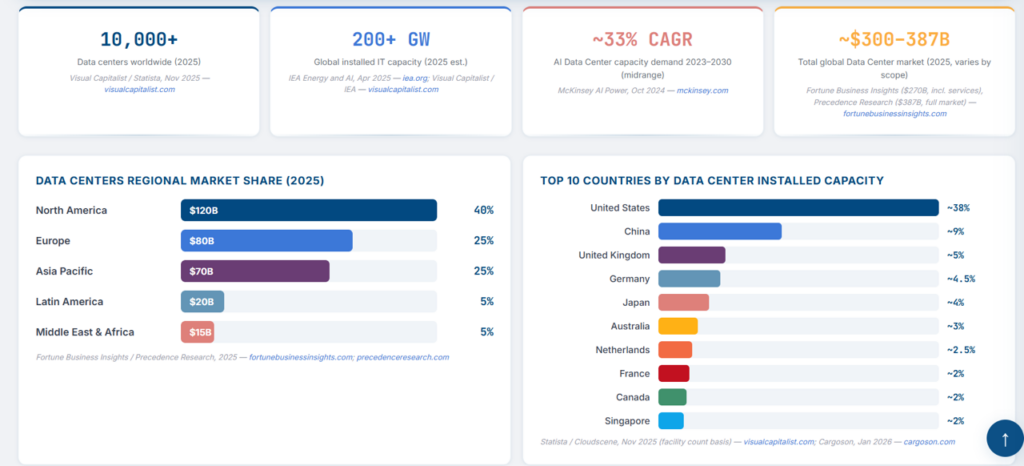
Texas leads the nation with 140 data centers under construction, narrowly ahead of Virginia, which has 136, according to Visual Capitalist. After those two, there is a sharp drop to Georgia at 56 and Ohio at 51.
Globally, the report cited 4,088 data centers in the U.S. (43 percent of the world’s total), followed by Germany (507), the U.K. (506), China (396), France (346), and Canada (286).
Discover how UL Solutions supports data centers with safety, security, sustainability, performance and market access offerings, learn more here!
In fast-growing markets, the report continued, the surge in electricity demand is beginning to test grid capacity and raise questions about how quickly utilities can keep pace. “In Texas, developers have created levels of demand that could be impossible to meet.”
Pew Research Center, meanwhile –– citing its analysis of data from Data Center Map –– suggests that the U.S. has more than 3,000 operational data centers, with more than 1,500 new facilities in various stages of development nationwide. Some two-thirds of the planned data centers are in rural areas, it added.
A Glutton for Energy and Water
In a November 2025 research paper titled “The Future of Data Centers,” the Brookings Institution reported that data centers in 2023 consumed roughly 4.4 percent of America’s electrical power, but it projects that share will grow significantly. Globally, it estimates that AI’s energy needs could account for as much as 21 percent of all electricity usage by 2030.
Water is a problem, too, according to Brookings. Data centers require a lot of water to cool the buildings and the computers inside. Electronic devices heat up during processing, and when thousands of file servers are grouped in a small area, the cooling needs increase dramatically.
“Some data centers consume as much as 500,000 gallons per day,” Brookings said, “making them a substantial draw on what is a limited resource in many communities.” Others say that the supersized, hyperscale data centers can consume up to 5 million gallons daily.
McKinsey has estimated a 33 percent compound annual growth rate in data center installed capacity between 2023 and 2030. As of 2025, the biggest players (Microsoft, Google/Alphabet, Amazon/AWS, Meta, Apple and Oracle) had announced capital expenditure plans totaling some $315 billion. This is driving huge consumption of polymers for a vast menu of applications.
Polymers’ Role in This Construction Explosion
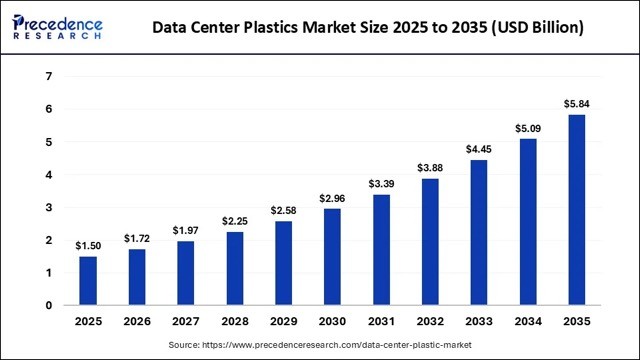
Few studies have tried to quantify how much plastic is used in AI data centers, but one research firm has offered an estimate. Pune, India-based Precedence Research Pvt. Ltd. estimates the data center plastics market will soar from $1.72 billion this year to $5.84 billion in 2035.
It says that North America dominated the sector with 39 percent market share in 2025, followed by Asia Pacific’s 29 percent. It projects the latter region will register a 17.8 percent compound annual growth rate (CAGR) between now and 2035.
Polyvinyl chloride (PVC) was the most widely used polymer, accounting for some 24 percent of plastics used. While polyether ether ketone (PEEK) resin held about a 5 percent share of the resins used, Precedence projects it to grow at the fastest rate, by nearly 20 percent per year, over the next decade. Some also foresee strong opportunities for polyethylene and polypropylene piping and related products. Various engineered plastics are needed in these data centers, including polycarbonate, ABS, PBT, PPS, polyamide, fluoropolymers, and liquid crystal polymers, among others.
These materials offer many properties such as electrical, flame, and thermal resistance, and lightweight construction. They help to deliver long service life to the server, connectors, cable management system, cooler assemblies, and power distribution units.
A UL Webinar Takes a Closer Look
In mid-July, Megan Kravec, industrial market and product manager for Streetsboro, Ohio-based Aurora Material Solutions, teamed with Mike Schaefer, commercial director – data centers for Hastings, Minn.-based molder Intek Plastics, to present a webinar organized by UL Solutions. The pair provided a detailed background to the current data center scene and key applications served by AMS’ portfolio of products.
Intek Plastics has also published white papers describing the growing role of polymers in data center infrastructure. In one, titled “How Plastics are Powering Data Center Innovation,” Intek states: “Plastics are increasingly being chosen over traditional materials like metal, glass and rubber in data centers due to their unique combination of benefits. Engineered plastics offer an exceptional balance of strength, weight and flexibility, often at a lower cost than alternative materials.
“Their ability to be precisely tailored for specific thermal, mechanical and chemical performance characteristics makes them ideal for demanding environments. In addition to cost-efficiency and performance, plastics can contribute to improved energy efficiency and design flexibility, making them a smart choice for modern, high-performance systems where both function and sustainability matter.”
Part 2 of this report will take a closer look at specific data center applications and the polymers being used to meet those requirements.

The views, opinions and technical analyses presented here are those of the author or advertiser, and are not necessarily those of ULProspector.com or UL Solutions. The appearance of this content in the UL Prospector Knowledge Center does not constitute an endorsement by UL Solutions or its affiliates.
All content is subject to copyright and may not be reproduced without prior authorization from UL Solutions or the content author.
The content has been made available for informational and educational purposes only. While the editors of this site may verify the accuracy of its content from time to time, we assume no responsibility for errors made by the author, editorial staff or any other contributor.
UL Solutions does not make any representations or warranties with respect to the accuracy, applicability, fitness or completeness of the content. UL Solutions does not warrant the performance, effectiveness or applicability of sites listed or linked to in any content.