


Epoxy coatings are often associated with the familiar two-component epoxy–amine system, but epoxy functionality supports a much broader set of coating technologies. Depending on resin architecture and cure route, an epoxide may form the primary network, react with a carboxyl-functional binder during baking, promote adhesion at an inorganic interface, or serve as the starting point for an acrylated oligomer whose final network forms through vinyl polymerization.
An “epoxy coating” should be defined by both its functional groups and its cure mechanism. Those choices determine the application method, processing window, defects to control, and achievable balance of adhesion, corrosion resistance, flexibility, appearance, and durability.
A broader view of epoxy functionality
In our earlier UL Prospector article, “Chemistry of Ambient Cure Epoxy Resins and Hardeners,” we reviewed resin and hardener choices used in conventional ambient-cure epoxy systems. Readers seeking additional background on resin structure, hardener selection, stoichiometry, pot life, and ambient-cure considerations can review that article before continuing here. These systems are built by reacting an epoxy resin commonly a glycidyl ether with an active hydrogen curing agent such as an amine, polyamide, amidoamine, or phenalkamine. The epoxy ring opens, and a crosslinked film forms without relying on oxygen from the air.
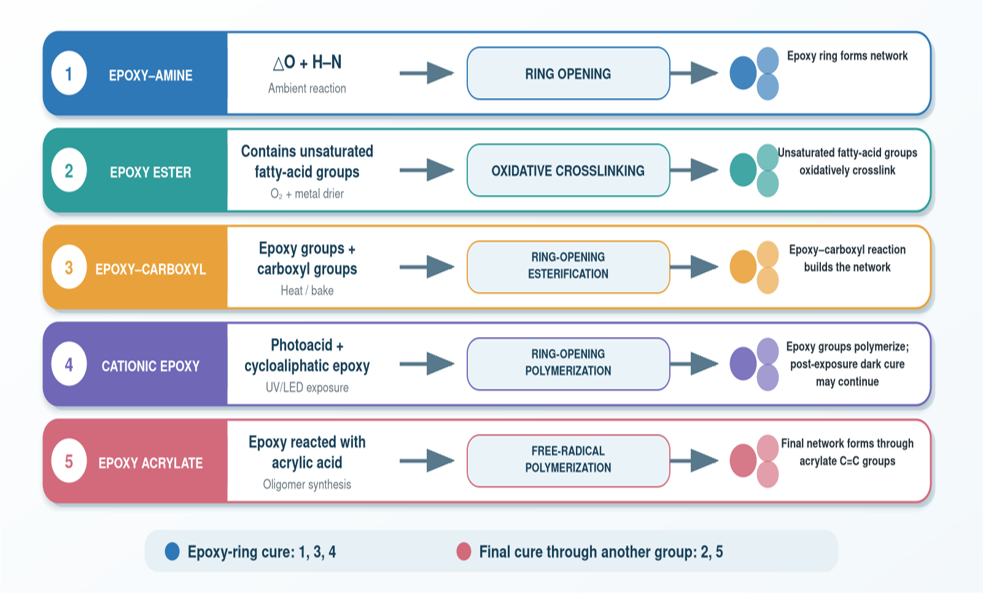
The term epoxy spans technologies that cure in very different ways. An epoxy ester with appropriate unsaturation may air-dry by oxidation; an epoxy-functional material may also crosslink a carboxyl-functional polymer during baking; and lastly a cycloaliphatic diepoxide epoxy may polymerize cationically after UV exposure. An epoxy acrylate normally cures through acrylate double bonds by a free-radical mechanism. The epoxy origin contributes useful structure, but another functional group may form the final film.
Epoxy as a primary binder and as a crosslinker
In a conventional two-package system, the epoxy resin is the primary film-forming binder. Epoxy equivalent weight (EEW) and the hardener’s active hydrogen equivalent weight (AHEW) establish the stoichiometric starting point. Functionality, backbone structure, hardener type, temperature, film thickness, induction time, and application conditions then determine working time and final performance.
Epoxy functionality can instead serve mainly as a crosslinking site for a carboxyl-functional polymer. In many advanced bisphenol-A epoxy resins, increasing molecular weight lowers epoxide concentration per unit mass while increasing the contribution of secondary hydroxyl functionality. Those hydroxyl groups may also participate in reactions with phenolic, amino crosslinkers (melamine, urea formaldehyde), or isocyanate crosslinkers in thermal cure systems. Resin name alone therefore does not define cure chemistry; the functional-group balance does.
Epoxy as a primary binder and as a crosslinker
In a conventional two-package system, the epoxy resin is the primary film-forming binder. Epoxy equivalent weight (EEW) and the hardener’s active hydrogen equivalent weight (AHEW) establish the stoichiometric starting point. Functionality, backbone structure, hardener type, temperature, film thickness, induction time, and application conditions then determine working time and final performance.
Epoxy functionality can instead serve mainly as a crosslinking site for a carboxyl-functional polymer. In many advanced bisphenol-A epoxy resins, increasing molecular weight lowers epoxide concentration per unit mass while increasing the contribution of secondary hydroxyl functionality. Those hydroxyl groups may also participate in reactions with phenolic, amino, or isocyanate crosslinkers in thermal systems. Resin name alone therefore does not define cure chemistry; the functional-group balance does.
Air-dry epoxy esters are not ambient-cure epoxy–amine coatings
Unsaturated Epoxy esters are produced by reacting epoxy resins with drying-oil fatty acids. With sufficient unsaturation, they cure by oxidative air-drying, much like alkyds. Oxygen uptake produces peroxide intermediates and eventually a crosslinked film, usually with the assistance of metal driers. The epoxy-derived portion can improve adhesion, hardness, and resistance, while the fatty-acid structure enables one-package use.
A two-component epoxy–amine film cures by addition between resin and hardener; an air-dry epoxy ester depends on oxygen diffusion and oxidation. Film thickness, temperature, airflow, pigments, and drier balance therefore affect the systems differently. Such epoxy esters are utilized in one-component metal primers, maintenance coatings, and industrial finishes, but they should not automatically be considered to have the chemical resistance of a well-cured two-component epoxy.
Thermal cure epoxy systems
Thermal cure expands epoxy’s role. In selected liquid, powder, coil, can, and industrial coating systems, epoxy groups react with carboxyl groups on acrylic or polyester resins. This ring-opening reaction forms ester linkages and increases molecular weight and crosslink density during baking. Equivalent ratio, acid value, EEW, catalysts, pigment surfaces, film thickness, metal temperature, and time at temperature affect conversion, appearance, and storage stability.
Hybrid powder coatings, for example, combine solid aromatic epoxy resins with carboxyl-functional polyesters. They can provide useful flow, appearance, mechanical performance, and chemical resistance for indoor metal products. Their exterior durability is generally constrained by the aromatic epoxy component, so more weatherable chemistries are typically selected when long-term outdoor gloss and color retention are essential.
Glycidyl-functional acrylics provide another route: pendant glycidyl groups react with carboxyl-functional materials during thermal cure. Functionality and polymer architecture can be adjusted to balance hardness, flexibility, resistance, and bake response. Oven air temperature alone does not establish cure; part temperature and time at temperature are the more relevant measures.
Cathodic electrocoat: a major epoxy application
Cathodic electrocoat, often called CED or cathodic e-coat, is among the largest-volume applications of epoxy-based binder technology. It is best known as the corrosion-resistant primer on automotive bodies, but it is also used on frames, chassis parts, agricultural and construction equipment, appliances, HVAC parts, electrical enclosures, fasteners, and other complex metal assemblies.
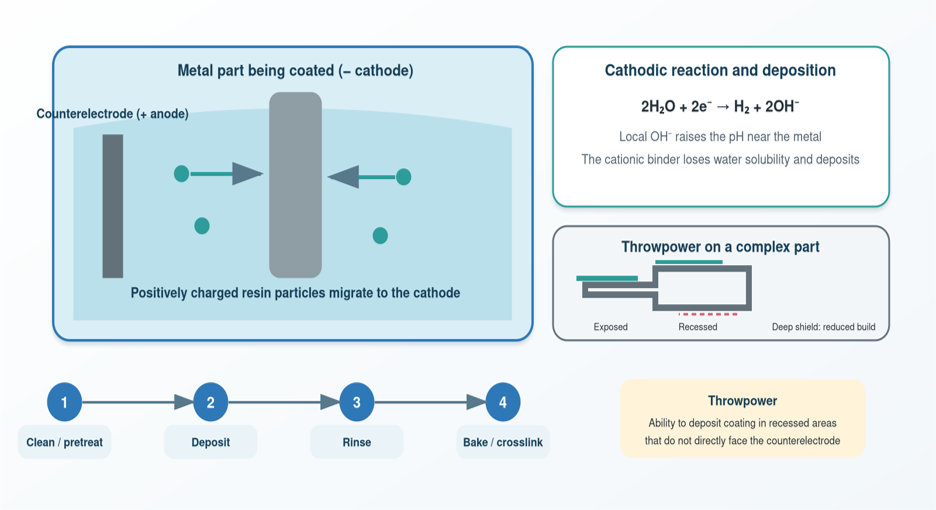
In a typical system, an epoxy resin is modified with amine functionality and neutralized with acid so it can be dispersed in water. The metal part being coated is connected as the cathode. When direct current is applied, positively charged resin particles move toward the metal surface. Water reduction at the cathode generates hydroxide ions and raises the local pH, causing the binder to lose its water solubility and deposit as a continuous film. The coated part is then rinsed to remove excess bath material and baked to complete crosslinking, commonly through a blocked polyisocyanate or another heat-activated crosslinker.
Electrical deposition followed by thermal cure offers controlled film build, efficient material use, and uniform coverage of complex areas on a properly pretreated substrate. Throwpower describes the ability of an electrocoat bath to deposit film in recessed or electrically shielded areas. Voltage, conductivity, bath temperature, solids, pH, contamination, pretreatment, part geometry, and formulation all influence deposition.
Electrocoat performance is a complete-system property, not simply a resin property. Pretreatment, bath control, application conditions, part geometry—including joints, overlaps, edges, and recesses—and bake conditions work together to determine corrosion protection. A salt-spray result from one commercial system should not be generalized to every epoxy electrocoat. OEM qualification normally combines corrosion, adhesion, appearance, and process-control tests appropriate to the substrate and assembly.
Cationic UV/LED curing of cycloaliphatic epoxies
Cycloaliphatic epoxies can cure through a photoinitiated cationic mechanism. An onium-salt photoinitiator generates a strong acid under suitable radiation; the acid opens an epoxy ring and initiates reaction with additional epoxy or oxetane groups. Compared with many free-radical acrylate systems, this mechanism is not inhibited by atmospheric oxygen and typically produces lower polymerization shrinkage.
Cationic systems can continue to polymerize after irradiation because the photo-generated acid remains active; this is commonly called dark cure. It can improve conversion after exposure, but it is not equivalent to guaranteed cure in a fully shadowed area. Shadow performance still depends on acid mobility, film thickness, temperature, pigmentation, and whether a secondary cure mechanism is available. Cure speed and depth also depend on lamp output, absorption, moisture, basic contaminants, and molecular mobility.
UV LED sources offer energy efficiency, low heat input, and long service life, but their narrow emission bands require a matched photoinitiator or sensitizer package. Cationic cycloaliphatic systems are used in coatings, adhesives, 3D-printing materials, and electronic protection where adhesion, chemical resistance, dimensional stability, and low shrinkage are important.
Epoxy acrylates: epoxy-derived, free-radical cured
Epoxy acrylates illustrate why nomenclature must be interpreted carefully. They are commonly made by reacting epoxy groups with acrylic acid to introduce polymerizable acrylate unsaturation. During UV or electron-beam curing, the network normally forms through those carbon–carbon double bonds by a free-radical mechanism, not through polymerization of the original epoxy rings, which are typically consumed during oligomer synthesis. Epoxy acrylates are valued for fast cure, hardness, gloss, and chemical resistance. Depending on structure, limitations can include high viscosity, yellowing, and reduced flexibility. Reactive diluents, other oligomers, pigments, additives, and cure conditions adjust processing and properties. Free-radical acrylate cure is also susceptible to oxygen inhibition at the surface, unlike cationic epoxy cure.
Epoxy-functional silanes and organic–inorganic hybrids
Epoxy-functional silanes contain two types of reactivity. The epoxy group can participate in, or remain compatible with, the organic resin network. Hydrolyzable alkoxysilane groups form silanols that can condense with hydroxylated inorganic surfaces or with other silanols. Under compatible conditions, the silane can help connect an organic coating to glass, metal oxides, mineral fillers, ceramics, or siliceous substrates.
For these materials, formulation sequence matters as much as chemistry. Hydrolysis, pH, water content, substrate cleanliness, cure conditions, and concentration influence performance. Premature hydrolysis or excess silane can favor self-condensation instead of interfacial bonding. These silanes may act as adhesion promoters, resin modifiers, crosslinking components, or surface treatments, but the benefit must be verified in the complete formulation
Dual-cure systems
A dual-cure coating combines two mechanisms to overcome a limitation of either one alone. A rapid UV step may provide handling strength and line speed, followed by thermal, moisture, or ambient cure in shadowed regions. For example, an acrylate network can provide immediate surface hardness while a secondary moisture- or heat-activated reaction develops conversion in areas that receive insufficient radiation. Free-radical acrylate and cationic epoxy photochemistry can also be combined to balance surface cure, adhesion, shrinkage, flexibility, and post-cure development. Dual cure is useful for three-dimensional parts, pigmented films, shaded assemblies, and electronics needing immediate fixturing. It also adds control requirements: the reactions must remain compatible during storage and application, and the first network must not restrict the second before adequate conversion is reached.
Electronics and energy-storage applications
In electronics and energy systems, epoxies serve as conformal coatings, encapsulants, potting compounds, adhesives, insulating varnishes, and protective layers. Their adhesion, electrical insulation, chemical resistance, and dimensional stability can be tailored, but requirements extend well beyond those of a general industrial coating.
Battery, fuel-cell, electrolyzer, and power-electronics materials may face moisture, ions, thermal cycling, process fluids, and demanding dielectric or flame requirements. Ionic purity, cure completeness, glass-transition temperature, thermal expansion, hydrolytic stability, extractables, and compatibility with metals or electrolytes can be critical. Functional fillers may help, but they also affect viscosity, settling, cure, and interfacial stress.
Bio-based epoxies and reprocessable networks
Development now addresses renewable feedstocks and what happens after a coated product reaches the end of its useful life. Bio-based epoxies have been developed from vegetable oils, cardanol, lignin-derived aromatics, sugars, and other renewable sources. “Bio-based” identifies raw-material origin; it does not guarantee performance, lower hazard, lower carbon footprint, or recyclability. Cure, viscosity, color, stability, glass-transition temperature, and durability must still fit the application.
Where a quantitative bio-based claim is made, the basis and measurement method should be identified. Renewable feedstock origin alone does not establish the amount of biogenic carbon in the final coating or its environmental advantage.
Reprocessable networks address repair and material recovery differently. Unlike conventional thermosets, vitrimers and other covalent adaptable networks contain bonds that exchange under heat or another stimulus. They may relax stress, repair, reshape, or aid recycling while remaining crosslinked in service. For thin coatings, however, high reprocessing temperatures, catalyst effects, creep resistance, retained adhesion after aging, weathering, and scale-up remain important constraints. Controlled debonding may be more useful than bulk reshaping
Process, VOC, and compliance considerations
Cure route also affects manufacturing controls and regulatory strategy. Ambient, epoxy-ester, and many liquid coating systems may require management of solvent content, VOC emissions, worker exposure, and flash-off conditions. Powder and electrocoat technologies can reduce solvent emissions, but they introduce other controls, including bake energy, bath maintenance, wastewater management, ultrafiltration, and process monitoring. UV, LED, and electron-beam systems can support low-solvent or solvent-free production, yet photoinitiator selection, extractables, odor, cure validation, and exposure controls may remain important.
“Low VOC” should not be treated as equivalent to low hazard, low carbon footprint, or universal regulatory acceptance. The applicable requirements depend on product category, jurisdiction, end use, and manufacturing process. Formulators should verify current limits and reporting obligations against the relevant federal, state, local, and customer requirements before making compliance claims.
A practical framework for selecting epoxy technology
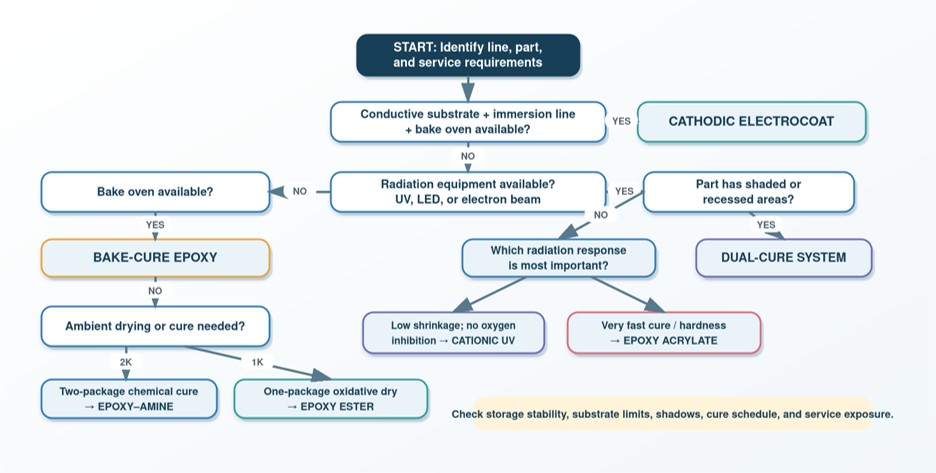
The first formulation question should not be “Which epoxy should we use?” but “Which cure mechanism and application process fit the substrate, production line, and service environment?” Once that is clear, epoxy functionality can be assigned the appropriate role.
- Use ambient epoxy–amine chemistry when room-temperature chemical cure, adhesion, barrier performance, and high-build application are required.
- Use an epoxy ester when one-package oxidative drying and metal-primer application matter more than maximum immersion or chemical resistance.
- Use carboxyl–epoxy or related bake chemistry when the substrate and line can support controlled thermal cure.
- Use cathodic epoxy electrocoat when uniform primer deposition, recessed-area coverage, material efficiency, and high-volume metal finishing are central requirements.
- Use cationic cycloaliphatic epoxy cure when low shrinkage, adhesion, and freedom from oxygen inhibition justify radiation curing.
- Use epoxy acrylates when very fast free-radical UV/EB cure, hardness, gloss, and chemical resistance are desired.
- Use epoxy-functional silanes or dual-cure designs when interfacial bonding or cure in difficult geometries is a controlling need.
The epoxy family is valuable precisely because it is not limited to one resin, hardener, or cure route. Identifying which functional group reacts and under what process conditions, allows formulators to use epoxy chemistry deliberately instead of treating all “epoxy” coatings as variations of the same system.
Summary comparison
| Technology | Main reactive groups | Cure trigger | Typical strengths |
| Ambient epoxy | Epoxy + active hydrogen | Mixing; ambient/low heat | Adhesion, barrier, chemical resistance |
| Epoxy ester | Fatty-acid unsaturation | Oxygen + drier | One-package handling, adhesion, hardness |
| Bake-cure epoxy | Epoxy + carboxyl or other thermal crosslinker | Time at metal temperature | Flow, hardness, production efficiency |
| Cathodic e-coat | Cationic epoxy-based binder + bake crosslinker | DC deposition + bake | Uniform primer, throwpower, corrosion protection |
| Cationic UV epoxy | Cycloaliphatic epoxy/oxetane | Photoacid + radiation | Low shrinkage, no oxygen inhibition, dark cure |
| Epoxy acrylate | Acrylate double bonds | Free radicals from UV/EB | Fast cure, hardness, gloss, chemical resistance |
| Epoxy silane/hybrid | Epoxy + hydrolyzable silane | Chemical, moisture, and/or thermal cure | Adhesion to inorganic surfaces, hybrid network |
| Dual cure | Two complementary functional sets | Two sequential or parallel triggers | Shadow cure, handling strength, property balance |
References
- Chemistry of Ambient Cure Epoxy Resins and Hardeners — https://www.ulprospector.com/knowledge/12910/pc-chemistry-of-ambient-cure-epoxy-resins-and-hardeners/
- Epoxy Coatings: Chemistry, Applications, Curing, and Problem-Solving — https://www.ulprospector.com/knowledge/19032/pc-epoxy-coatings-chemistry-applications-curing-and-problem-solving/
- Polyurethane, Silicone and Epoxy Resins for Fuel Cells, Electrolysers and Other Energy Storage Devices — https://www.ulprospector.com/knowledge/14048/pe-webinar-polyurethane-silicone-and-epoxy-resins-for-fuel-cells-electrolysers-and-other-energy-storage-devices/
- PPG—Electrocoat — https://www.ppg.com/en-US/autocoatings/solutions/electrocoat
- Arkema—Cationic Resins for UV/LED/EB Curing — https://coatingmaterials.arkema.com/en/technologies/uv-led-eb-curable-resins-additives/cationic-resins/
- Allnex—Epoxy Acrylates — https://allnex.com/en/technologies/acrylate-crosslinkers/epoxy-acrylates
- Allnex—Powder Coating Resins — https://allnex.com/en/technologies/powder-coating-resins
- Evonik—Epoxy-Functional Silanes in Epoxy Applications — https://www.evonik.com/en/applications/application_111266.html



The views, opinions and technical analyses presented here are those of the author or advertiser, and are not necessarily those of ULProspector.com or UL Solutions. The appearance of this content in the UL Prospector Knowledge Center does not constitute an endorsement by UL Solutions or its affiliates.
All content is subject to copyright and may not be reproduced without prior authorization from UL Solutions or the content author.
The content has been made available for informational and educational purposes only. While the editors of this site may verify the accuracy of its content from time to time, we assume no responsibility for errors made by the author, editorial staff or any other contributor.
UL Solutions does not make any representations or warranties with respect to the accuracy, applicability, fitness or completeness of the content. UL Solutions does not warrant the performance, effectiveness or applicability of sites listed or linked to in any content.