

 A paint batch can look fine in the can and still fail where it matters: on the surface. It must spread without excessive spatter, cover the substrate, dry evenly, develop the intended sheen, and withstand cleaning or weathering in service.
For example, flat white wall paint illustrates how closely these requirements are connected. Adding an extender may lower sheen, but it can also affect hiding, scrub resistance, porosity, and application behavior. Formulation is therefore not simply a matter of selecting raw materials. It is a process of balancing ingredients, processing conditions, application method, and finished-film performance.
Start with the finished surface
Paint is predominantly a pigmented coating. The broader term coating also includes clear finishes, protective films, and materials designed primarily for functional or aesthetic properties like corrosion resistance, chemical resistance, abrasion resistance, color and appearance.
Formulation should begin with consideration of the function the coating must perform:
- Substrate – drywall, steel, concrete, wood, plastic or other?
- Application – Will the paint be brushed, rolled, sprayed, dipped, reverse or direct roll coated, electrodeposited or factory applied?
- What exposure will it face after cure?
- Which properties are essential: opacity, washability, corrosion protection, flexibility, chemical resistance, appearance, gloss color and film integrity upon exterior exposure and low or no VOC?
Those answers guide the selection and optimization of binder, pigments, additives, carrier, curing mechanism, and test methods.
Waterborne systems use water as the principal liquid carrier. Solventborne systems rely mainly on organic solvents. High-solids liquid coatings reduce the proportion of carrier, while powder coatings are applied without a liquid carrier. Other useful distinctions include binder chemistry, curing mechanism, application equipment, and exposure conditions. No single label determines VOC content or coating performance on its own.
Main coating types
Coating names often describe different features of the same product. Waterborne identifies the carrier, acrylic identifies a binder family, flat describes appearance, and direct-to-metal describes intended use. One coating can fit all four descriptions.
| System | How it forms a film | Examples and formulation priorities |
| Waterborne dispersion | Water and cosolvents evaporate; latex particles pack and coalesce, sometimes followed by additional crosslinking | Architectural acrylic and vinyl-acrylic paints; protect freeze-thaw stability, film formation, and microbial stability |
| Water-reducible or waterborne reactive | Water and cosolvent leaves, followed by resin reaction or cure where applicable | Waterborne epoxies and polyurethanes; control pot life, water sensitivity, and mixing ratio |
| Solventborne | Organic solvent evaporates; the resin remains or undergoes further cure | Alkyd, acrylic, epoxy, and polyurethane systems; address solvent release, safety, cure, and VOC |
| High-solids liquid | A larger percentage of the wet coating becomes dry film | Industrial primers and topcoats; control viscosity, atomization, sag resistance, and cure |
| Powder | Solid particles are deposited, melted, flowed, and usually cured with heat | Appliances, architectural metal, and industrial components; control bake window, film build, and edge coverage |
| UV/EB-cured | Reactive ingredients polymerize under ultraviolet light or electron-beam radiation | Wood, packaging, and factory-applied finishes; control cure depth, shadowing, and exposure |
Substrate and service conditions narrow the choices. A masonry façade may use a mineral silicate coating designed to allow vapor movement. A steel component may require a direct-to-metal barrier coating or a primer/topcoat system. A factory-coated appliance may be better suited to powder. Interior drywall paint usually places greater emphasis on hiding, appearance, washability, and ease of application.
ULTRUS® software solutions connect product life cycle data, regulatory content and expertise and AI-driven automation and analytics. Learn more here!
VOC must be assessed for the specific formula and the applicable reporting method, including any solvent or thinner added at the point of use.
Further reading: Formulating Silicate Paints for Modern Architectural Applications; Waterborne Silicate Coatings: The Ultimate Eco-friendly Coating; Direct-to-Metal Coatings: Evolving Chemistry, Elevated Performance, and Enhanced Sustainability; and Architectural Coatings: Next-Generation Innovations and Market Shifts.
What goes into a liquid paint
| Ingredient family | Contribution to the formula | Formulation question |
| Binder | Forms the continuous film and binds particles together | Will it form a durable, adherent film under the intended drying conditions? |
| Pigments and extenders | Provide color, hiding, texture, sheen control, and body | How will particle size, shape, and loading affect packing and binder demand? |
| Carrier | Makes the material workable during mixing and application | How will the liquid phase affect flow, drying, and VOC? |
| Additives | Control dispersion, foam, rheology, wetting, preservation, and other properties | Does the additive solve its target problem without creating a new compatibility or stability issue? |
Titanium dioxide supplies much of the hiding in a white paint. Calcium carbonate, clay, and other extenders are added to help control appearance, sheen, rheology, particle packing, and cost. The binder has a major influence on adhesion, toughness, water resistance, and durability. Additives are often used at low levels, but a dispersant, defoamer, thickener, or wetting agent can determine whether the paint can be manufactured and applied consistently.
Starting point: flat white paint
The table below provides a practical starting range for a waterborne interior flat paint. It is expressed as weight percent of each ingredient as supplied. These ranges are not a single validated formula, and the endpoints do not add to 100%. Select the pigment blend and binder first, reserve water for letdown and viscosity adjustment, then balance the final formula to100%.
Supplier solids, density, recommended use level, and compatibility should be verified for every raw material.
| Ingredient as supplied | Starting range, wt% | Role and formulation decision |
| Water | Balance to 100 | Carrier; reserve a portion for letdown and final adjustment |
| Titanium dioxide | 8–18 | White or pastel color, hiding; select grade and level based on opacity target |
| Calcium carbonate | 15–35 | Extender; select particle size, brightness, and absorption, cost savings |
| Clay or other matting extender | 3–12 | Flatness, body, texture, and particle packing |
| Acrylic latex dispersion | 15–30 | Film former; select solids, glass-transition behavior, and minimum film-formation temperature |
| Dispersant | 0.2–0.8 | Stabilizes pigment and extender dispersion; follow supplier guidance |
| Defoamer | 0.1–0.5 | Controls entrained and surface foam |
| Rheology modifier | 0.1–1.0 | Builds storage and application viscosity |
| Coalescent | 0–1.5 | Used as needed for film formation and VOC target |
| In-can preservative | Supplier-approved dose | Select for the system, microorganism challenge, and intended market |
These are mixer-charge amounts, not dry-film percentages. Latex contributes water, and some additives are supplied in solvent or aqueous solutions. Once a trial is selected, calculate solids, pigment volume concentration, and expected VOC separately. Then evaluate viscosity, application, and the dried film.
A formula table alone cannot establish that a coating will meet a specified sheen, opacity, scrub-resistance, or VOC claim.
From design brief to laboratory batch
Before choosing ingredients, define what the paint needs to do. Consider the surface it will cover, how it will be applied, the conditions it will face, and the finish and durability required. Set targets for hiding, drying time, film thickness, storage stability, and VOC content.
| Design question | Starting decision | What to verify |
| How will the coating dry? | Select binder and coalescence strategy for actual application temperature | Film continuity, adhesion, early water response |
| How opaque should it be? | Select TiO₂ grade and loading, then design the extender blend by volume | Contrast ratio at controlled dry-film thickness and tint strength to provide hiding at the desired dry film thickness |
| What finish is required? | Set an initial PVC range and choose particle size and rheology package | Measured sheen, burnishing, and scrub resistance |
| How will it be applied? | Match low- and high-shear rheology to brush, roller, or spray | Transfer, spatter, leveling, and sag resistance |
| Where will it be used? | Identify substrate preparation and primer requirements | Wetting, adhesion, and aging on the actual substrate |
Normalize the selected wet ingredients to 100 wt%. Record the nonvolatile fraction and density for each supplier grade. Only dry polymer contributes to binder volume in PVC calculations. Water supplied with latex belongs in the water balance, while additives may contribute solids, water, solvent, or VOC.
Making the batch
Waterborne paint is typically made in two stages: grind and letdown.
During the grind, water, dispersant, and selected additives wet the pigments and extenders while the mixer breaks down agglomerates. During letdown, the latex binder and remaining ingredients are added under a shear level the system can tolerate. Raw-material instructions and a small compatibility trial should determine the exact order of addition.
Begin with a clean vessel, verified raw materials, calibrated scales, and a batch sheet that records actual charges and observations. Hold back part of the water for letdown and final viscosity adjustment. Once the water and dispersing package are circulating, add titanium dioxide and extenders slowly enough to wet each addition fully.
Powder collecting on the vessel wall is significant. Intense motion near the blade does not prove that the entire vessel is mixing effectively.
During the grind, record batch temperature, appearance, foam, and fineness at intervals. Dispersion involves wetting, deagglomeration, and stabilization. More shear may initially improve fineness, but excess energy can entrain air, heat the batch, or damage a shear-sensitive ingredient. Choose a practical endpoint by comparing fineness, color development, rub-up, and film properties over time.
Reduce to the appropriate letdown shear before adding the latex. Then add remaining water, rheology modifiers, and other late-stage ingredients in the sequence specified by their suppliers. Some associative thickeners require controlled dilution and adequate mixing time. Check pH where relevant, allow the batch to equilibrate, then make the final viscosity adjustment. Filter or strain only as appropriate for the product and packaging process.
Reserve a representative portion of the batch to evaluate fresh and aged samples.
| Batch stage | Record in the notebook | Stop and investigate when |
| Premix | Water source, charge order, wet-out, and pH where relevant | Powder floats, gels, or curdles on addition |
| Grind | Time, speed, temperature, fineness, rub-up, and foam | Circulation stalls or grind improvement plateaus |
| Letdown | Latex addition rate, compatibility, pH, and final viscosity | Seediness, coagulum, or sudden viscosity change |
| Fill and hold | Mass, density, container fill, and retained samples | Settling, skinning, pressure build-up, or phase separation |
Particle selection and hiding
The titanium dioxide level on a batch sheet does not tell the full hiding story. TiO₂ grade, dispersion quality, and particle spacing in the dry film influence how efficiently the pigment scatters light. When particles are crowded together, scattering efficiency can decrease. The right extender may improve spacing; the wrong extender may roughen the film or reduce coverage.
Compare pigment and extender substitutions by particle volume, not only by weight. Replacing equal weights of different minerals can change PVC because densities differ. Evaluate hiding at the same controlled dry-film thickness.
A fineness-of-dispersion gauge such as a Hegman grind Guage is useful for identifying coarse particles and agglomerates. It does not describe the complete particle-size distribution or confirm that TiO₂ has been optimally separated. For white paint, side-by-side drawdowns at the same dry-film thickness on a consistent black-and-white chart can reveal optical differences that a grind reading misses.
Further reading: Inert Pigments – The Unseen Contributor to Improving Paint Performance.
Calculating PVC
Ingredients are weighed into the mixer, but pigment volume concentration, or PVC, describes the proportion of the dry-film volume occupied by pigments and extenders.
For each dry pigment and extender, divide dry mass by true density and add the resulting particle volumes to obtain Vp. For each film-forming binder, multiply the supplied binder mass by its solids fraction, divide by dry-polymer density, and add the resulting binder volumes to obtain Vb.
Water and evaporating solvents are not included in either dry volume.
PVC (%) = 100 × Vp / (Vp + Vb)
Vp = Σ (dry pigment mass / true pigment density)
Vb = Σ (supplied binder mass × binder solids fraction / dry binder density)
Weight percent pigment cannot replace PVC because titanium dioxide, calcium carbonate, clay, and polymer have different densities. The as-supplied latex mass also cannot be treated as pure binder solids. Use measured or supplier-specific density and nonvolatile-content values for an actual formulation.
Estimating CPVC
Critical pigment volume concentration, or CPVC, is the point at which a particular pigment blend has just enough binder to fill the spaces among packed particles. Below this region, binder can form a continuous phase around the particles. Above it, unfilled voids may develop, changing hiding, sheen, porosity, permeability, and mechanical properties.
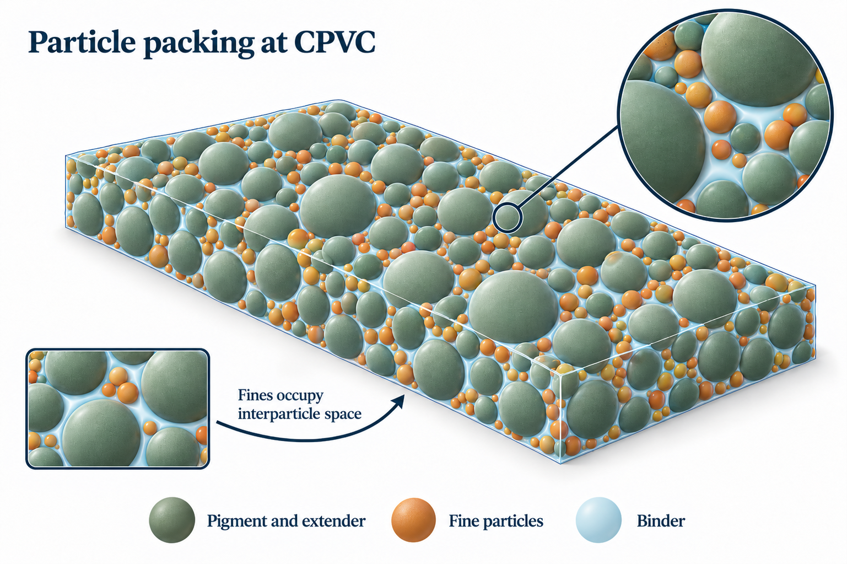
CPVC is system dependent. It is not a universal number for every flat paint.
One screening approach uses oil absorption, or OA. Let mi be the dry mass of pigment or extender i, ρi its true density, and OAi its oil absorption in grams of oil per 100 grams of dry powder. Let ρo be the density of the test oil, using consistent units.
Vp = Σ (mi / ρi)
Vo = Σ (mi × OAi / 100) / ρo
Estimated CPVC (%) ≈ 100 × Vp / (Vp + Vo)
If a representative pigment blend has a measured blend oil absorption, calculate the oil-demand mass directly from the total blend mass and measured blend OA. Individual ingredient OA values may not add linearly in a real blend, and a linseed-oil paste endpoint is not identical to packing and coalescence in latex paint. Use this calculation to select a starting point for laboratory trials, not as a certified CPVC value.
A PVC ladder is often the most useful follow-up experiment. Hold pigment blend and binder chemistry constant where possible, vary binder level, balance water, and track changes in volume solids, rheology, drying, sheen, opacity, scrub resistance, density, and permeability. Apply films at comparable dry-film thickness and add closer-spaced trials where a sharp property change appears.
Further reading: Effect of Pigment Volume Concentration on Coatings Properties – Part II.
Flatness and durability
As PVC rises, a coating surface often becomes less glossy because texture scatters more reflected light. Near or above CPVC, voids can increase dry hiding and lower sheen, but they can also make the film more porous and less resistant to cleaning or water.
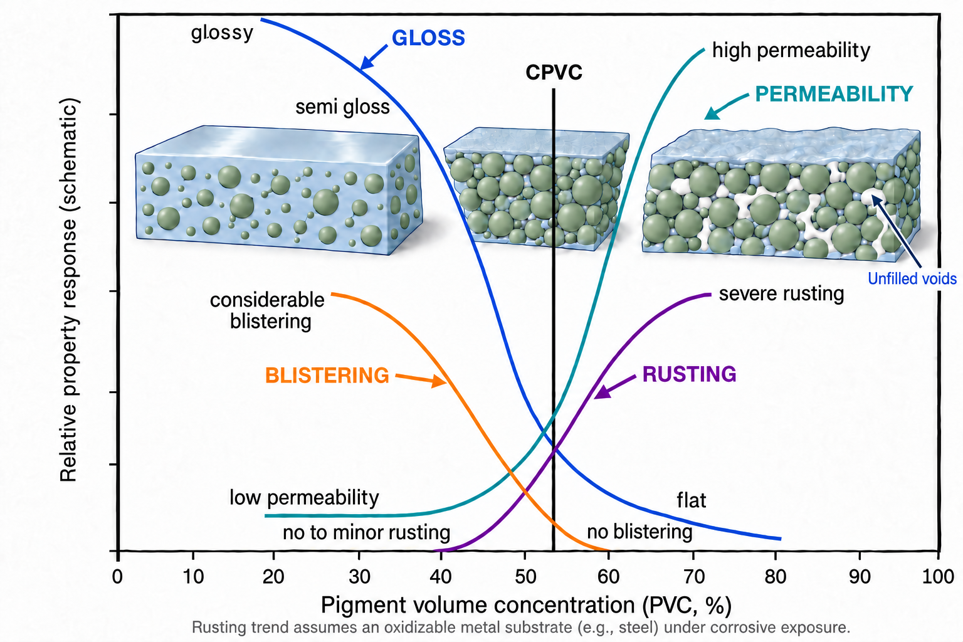
A flat paint may be formulated below or above CPVC depending on binder quality, pigment packing, matting strategy, film-formation conditions, and durability target. Eggshell and semi-gloss coatings generally require a smoother, more binder-rich surface. There is no universal PVC value for a given sheen category.
Compare films at the same dry-film thickness. Measure sheen and opacity, then test cleaning, burnishing, scrub resistance, and water response. If a flat coating looks appropriate but marks easily during cleaning, simply increasing PVC is unlikely to solve the problem. Reassess the binder, pigment blend, dispersion quality, and film-formation conditions.
Everyday formulation problems
A high-speed disperser must circulate the entire batch through the blade zone. Blade diameter, blade position, tank geometry, fill level, and viscosity all affect circulation. Increasing rpm alone will not correct every dead zone or dispersion problem.
Water quality can also affect a waterborne system. If one water source causes curdling while purified water produces a stable batch, control and compare water quality before changing the entire formula. Record conductivity and pH, and evaluate possible interactions between water, latex, dispersant, pigments, extenders, and additives.
Application adds another set of tradeoffs. A paint must thin under brush or roller shear to transfer and level, then recover sufficient structure to resist sag. Many architectural paints are non-Newtonian, so one viscosity result cannot describe all application conditions. A well-dispersed paint can still fail to wet an oily surface or a low-energy plastic. Consider substrate preparation and liquid surface tension before selecting a wetting additive.
Wetting, rheology, and scale-up
Substrate wetting and powder dispersion are related but separate issues. A droplet spreading on a clean panel is an application-wetting question. A powder incorporating into a liquid is a dispersion question.
Low surface energy or contamination can cause poor wetting, crawling, craters, or adhesion problems. Compare cleaned and as-received panels before changing additives. Where appropriate, measure or compare contact angle. A substrate-wetting additive may improve spread, but it can also influence foam, intercoat behavior, or film appearance. Evaluate both the wet edge and the dried coating.
Further reading: Fundamentals of Wetting; and A Guide to Providing the Perfect Coating Adhesion.
Rheology is shear dependent in many architectural paints:
- Low-shear structure helps prevent settling and sag.
- Intermediate-shear behavior affects leveling and roller transfer.
- High-shear viscosity influences pumping, brushing, and atomization.
A single rotational-viscometer measurement at one speed cannot describe the full rheological profile. Record temperature, measurement geometry, shear condition, and time since preparation, then confirm performance during actual application.
Further reading: Better Performance through Rheology.
For a disperser, blade tip speed is: Tip speed = πDN / 60, where D is blade diameter in meters and N is rotational speed in revolutions per minute.
A 0.10 m blade operating at 1,500 rpm has a tip speed of approximately 7.85 m/s. Tip speed describes how quickly the blade edge moves; it does not prove that all material in the tank experiences equivalent shear.
During scale-up, compare tank-to-blade ratio, blade clearance, fill height, vortex, circulation pattern, heat generation, and dispersion endpoint rather than copying rpm from a laboratory batch.
Laminar and turbulent describe flow patterns, not coating quality. In a straight pipe carrying a Newtonian liquid: Re = ρvD / μ.
For density 1,000 kg/m³, mean velocity 0.20 m/s, pipe diameter 0.010 m, and viscosity 0.10 Pa·s, the Reynolds number is 20, which is in the laminar range for that idealized pipe-flow example.
Paint mixing is more complex. Shear-dependent viscosity, yield stress, mixing blades, and vessel geometry require an appropriate apparent-viscosity or generalized-Reynolds-number treatment. A familiar pipe-flow threshold should not be applied directly to a disperser tank.
Test the failure mode
Testing is most useful when it answers a specific question.
| Observation | Likely question | Useful next comparison |
| Fresh paint curdles after a water change | Did ions, pH, or a raw-material interaction destabilize the latex? | Repeat with controlled DI/RO and plant water; record conductivity and pH |
| Extender replacement lowers hiding | Was replacement made by mass instead of equal particle volume, or did dispersion change? | Recalculate PVC; compare contrast ratio and tint strength at equal dry-film thickness |
| Flat paint burnishes during cleaning | Are surface particles insufficiently bound, or is film formation inadequate? | Compare a PVC ladder, scrub resistance, and controlled curing conditions |
| Pinholes or craters appear in a drawdown | Is the cause entrained air, substrate contamination, or poor wetting? | Draw down on a cleaned panel; compare mixing conditions and defoamer changes |
| Viscosity drifts after one week | Is there delayed thickener hydration, pH change, or flocculation? | Recheck pH, viscosity profile, rub-up, and settled material |
Further reading: Understanding Coating Defects: Identification, Root Cause Analysis, and Corrective Action in Industrial Coating Systems; and Overcoming Paint Film Defects: Causes and Remedies.
Measurements that make comparisons meaningful
Film thickness can hide an otherwise useful formulation comparison. A thicker coating may appear to hide better simply because more material was deposited.
As a first approximation on a nonabsorbing surface: Dry-film thickness = Wet-film thickness × Volume-solids fraction.
A paint at 40% volume solids applied at 100 µm wet-film thickness would be expected to leave approximately 40 µm dry film. This is a calculation example, not a measured result for any formula in the starting ranges. Surface absorption and drying behavior may require additional checks.
| Stage | Useful observation or measurement | Question answered |
| In the can | Viscosity at relevant shear, pH where applicable, settling, foam | Can the batch be stored and applied consistently? |
| During dispersion | Fineness gauge, color development, rub-up | Are coarse agglomerates present or are particles flocculating? |
| During drying | Application temperature, film appearance, drying, and coalescence | Does the latex form a continuous film? |
| On the dry film | Thickness, sheen, opacity, scrub resistance, washability | Does the finished surface meet its intended purpose? |
Binder selection matters as much as pigment selection. A latex with a minimum film-formation temperature above the application temperature may require a suitable coalescent or a different polymer design. Otherwise, a well-dispersed paint can dry into a weak or discontinuous film. In a low-VOC formulation, film formation and emissions goals must be solved together.
VOC and finished-film performance
Waterborne does not automatically mean VOC-free. Coalescents, additives, preservatives, and other ingredients may contribute VOC, while thinning can alter the as-applied value.
Any numerical VOC claim requires the product category, jurisdiction, reporting convention, actual ingredient composition, and an appropriate analytical or calculation method. The starting ranges in this article cannot be assigned a VOC value until specific ingredients and use levels are selected.
The objective is to meet the relevant VOC requirement without sacrificing the application and film performance that make the coating useful.
Further reading: Navigating New Regulatory Currents in the Global Coatings Industry.
Before the formula is ready
After the first batch, establish acceptance ranges for identity, density, pH where applicable, fineness, viscosity under defined conditions, color, opacity, sheen, and applied-film thickness. Retain samples for stability testing at temperatures relevant to storage and distribution.
When a formula changes, change one meaningful variable at a time and repeat the corresponding film test. Altering dispersant, binder, and extender simultaneously makes the result difficult to interpret.
A commercial coating must ultimately demonstrate package stability, application reproducibility, substrate compatibility, and performance after full cure or aging. It must also meet the relevant VOC method and support any product claims.
The formula provides a starting point. Experimental results determine the production formula.
References
- Lewarchik, Ronald, and Vishakha Makode. “Formulating Silicate Paints for Modern Architectural Applications.” Prospector Knowledge Center, April 8, 2026. /knowledge/21333/pc-formulating-silicate-paints-for-modern-architectural-applications/
- Lewarchik, Ronald. “Waterborne Silicate Coatings: The Ultimate Eco-friendly Coating.” Prospector Knowledge Center, November 30, 2018. /9072/pc-waterborne-silicate-coatings-ultimate-eco-friendly-coating/
- Lewarchik, Ronald, and Vishakha Makode. “Direct-to-Metal Coatings: Evolving Chemistry, Elevated Performance, and Enhanced Sustainability.” Prospector Knowledge Center, June 11, 2025. /19382/pc-direct-to-metal-coatings-evolving-chemistry-elevated-performance-and-enhanced-sustainability/
- Lewarchik, Ronald, and Vishakha Makode. “Architectural Coatings: Next-Generation Innovations and Market Shifts.” Prospector Knowledge Center, October 29, 2025. /knowledge/20228/pc-architectural-coatings-next-generation-innovations-and-market-shifts/
- Lewarchik, Ronald. “Inert Pigments – The Unseen Contributor to Improving Paint Performance.” Prospector Knowledge Center, December 4, 2015. /knowledge/3489/pc-inert-pigments-the-unseen-contributor-to-improving-paint-performance/
- Lewarchik, Ronald. “Effect of Pigment Volume Concentration on Coatings Properties – Part II.” Prospector Knowledge Center, August 15, 2014. /795/pc-pigment-volume-concentration-part-ii/
- Lewarchik, Ronald. “Fundamentals of Wetting.” Prospector Knowledge Center, October 26, 2022. /13758/pc-fundamentals-of-wetting/
- Lewarchik, Ronald. “A Guide to Providing the Perfect Coating Adhesion.” Prospector Knowledge Center, January 12, 2022. /knowledge/10127/pc-a-guide-to-providing-perfect-coating-adhesion/
- Lewarchik, Ronald. “Better Performance through Rheology.” Prospector Knowledge Center, September 12, 2019. /9796/pc-better-performance-through-rheology/
- Lewarchik, Ronald, and Vishakha Makode. “Understanding Coating Defects: Identification, Root Cause Analysis, and Corrective Action in Industrial Coating Systems.” Prospector Knowledge Center, June 10, 2026. /knowledge/21799/pc-understanding-coating-defects-identification-root-cause-analysis-and-corrective-action-in-industrial-coating-systems/
- Lewarchik, Ronald. “Overcoming Paint Film Defects: Causes and Remedies.” Prospector Knowledge Center, June 16, 2017. /6636/pc-overcoming-paint-film-defects-causes-remedies/
- Lewarchik, Ronald, and Vishakha Makode. “Navigating New Regulatory Currents in the Global Coatings Industry.” Prospector Knowledge Center, September 8, 2025. /knowledge/19835/pc-navigating-new-regulatory-currents-in-the-global-coatings-industry/
- Nolan, G. T., and Kavanagh, P. E. “Computer Simulation of Particle Packing in Acrylic Latex Paints.” Journal of Coatings Technology 67, no. 850 (1995). https://www.paint.org/wp-content/uploads/2021/09/jctNOV95-Kavanagh.pdf
- Asbeck, W. K. “Critical Pigment Volume Concentration Measurements: A Very Fast Method.” Journal of Coatings Technology 77 (2005). https://www.paint.org/ct-archives/critical-pigment-volume-concentration-measurements-a-very-fast-method/
- “The Dispersion Process.” Technical ebook. https://www.byk.com/en/service/ebooks/wetting-and-dispersing-additives/dispersion-process
- PCI Magazine. “High-Speed Dispersion.” https://www.pcimag.com/articles/110632-high-speed-dispersion
- American Coatings Association. “Application Defects in Architectural Coatings.” CoatingsTech. https://www.paint.org/coatingstech-magazine/articles/application-defects-in-architectural-coatings/
- American Coatings Association. “Advancing Sustainable Coatings.” CoatingsTech (2026). https://www.paint.org/coatingstech-magazine/articles/advancing-sustainable-coatings/
- ASTM International. ASTM D281, Standard Test Method for Oil Absorption of Pigments by Spatula Rub-out. https://store.astm.org/d0281-12r21.html
- Abbott, Steven. “Critical Pigment Volume Concentration.” Practical Coatings Science. https://www.stevenabbott.co.uk/practical-coatings/CPVC.php
- “Substrate Wetting.” Technical ebook. https://www.byk.com/en/service/ebooks/surface-additives/substrate-wetting
- S. Environmental Protection Agency. “Method 24: Surface Coatings.” https://www.epa.gov/emc/method-24-surface-coatings
- American Coatings Association. “Film Formation of Vinyl Acrylic Latexes: Effects of Surfactant Type, Water and Latex Particle Size.” Journal of Coatings Technology. https://www.paint.org/wp-content/uploads/2021/09/SEPT96_Film-Formation-of-Vinyl-Acrylic-Latexes.pdf
- Diebold, Michael, Robert Kwoka, and David Mukoda. “TiO₂ Scattering Optimization and Not-In-Kind Opacity Alternatives.” CoatingsTech (2013). https://www.paint.org/wp-content/uploads/2021/09/TiO2_Feb-2013.pdf
- ASTM International. ASTM D3730, Standard Guide for Testing High-Performance Interior Architectural Wall Coatings. https://store.astm.org/d3730-17.html
- ASTM International. ASTM D1210, Standard Test Method for Fineness of Dispersion of Pigment-Vehicle Systems by Hegman-Type Gage. https://store.astm.org/d1210-05r22.html
- ASTM International. ASTM D523, Standard Test Method for Specular Gloss. https://www.astm.org/d0523-14r18.html
- ASTM International. ASTM D2697, Standard Test Method for Volume Nonvolatile Matter in Clear or Pigmented Coatings. https://store.astm.org/d2697-03r21.html
- Flack, Kyle, Nicholas Foley, Tyrone Vaughn, Lisa Kicklighter, and John Mangano. “Driving Performance via Permanent Coalescent Choice in Low-VOC Architectural Paints.” CoatingsTech (2017). https://www.paint.org/wp-content/uploads/2021/09/Low-VOC-Architectural-Paints-Permanent-Coalescent_Apr-2017.pdf



The views, opinions and technical analyses presented here are those of the author or advertiser, and are not necessarily those of ULProspector.com or UL Solutions. The appearance of this content in the UL Prospector Knowledge Center does not constitute an endorsement by UL Solutions or its affiliates.
All content is subject to copyright and may not be reproduced without prior authorization from UL Solutions or the content author.
The content has been made available for informational and educational purposes only. While the editors of this site may verify the accuracy of its content from time to time, we assume no responsibility for errors made by the author, editorial staff or any other contributor.
UL Solutions does not make any representations or warranties with respect to the accuracy, applicability, fitness or completeness of the content. UL Solutions does not warrant the performance, effectiveness or applicability of sites listed or linked to in any content.