

 Eco-friendly might be one of today’s most overused marketing claims. It is often applied to various formulations like personal care products (i.e., shampoos, lotions, and sunscreens), household cleaners, and fabric care products. But what does “eco-friendly” mean? Merriam-Webster Online Dictionary simply defines it as “not environmentally harmful”.[1] To me, this is a broad definition. In the real world, an eco-friendly product usually means it causes less harm to the environment than another, commonly used product. If we define eco-friendly from this viewpoint, the definition shifts as expectations and technologies evolve. Studies of consumer attitudes have shown that nearly half of those polled don’t believe manufacturers are doing enough to implement eco-friendly products.
If we narrow our focus to just coatings, we can look at how the practical meaning of eco-friendly has changed over the years. From VOC regulations to eliminating harmful formulation ingredients, coatings have continually moved in the direction of increasingly eco-friendly products. The first coatings intentionally formulated to reduce negative environmental impact targeted air pollution from VOCs, a shorthand for Volatile Organic Compounds. Certain classes of solvents used in paints were found to contribute to ground-level ozone formation, leading to the layer of “smog” which blanketed cities, especially Los Angeles, in the 1960s.
VOC REGULATION
Passed into law in July of 1966, Rule 66, drafted by the Los Angeles County Air Pollution Control Board, placed limits on the emissions of certain VOCs from stationary sources. This helped spur the creation of the US Clean Air Act, a national rule limiting emissions of air pollutants, including VOCs, from coatings. Restrictions on VOC emissions from point (fixed or non-mobile) sources led to an expansion of coatings technologies used in factory-applied finishes. Technologies such as high-solids, UV curable, high-performance waterborne, and powder coatings were all initially developed as responses to restrictions on VOC emissions. Regulations limiting VOCs in non-point sources like architectural coatings soon followed.
REMOVING TOXIC INGREDIENTS
Making coatings more eco-friendly started with VOC reductions but soon expanded to address other sources of negative environmental effects. Removing hazardous materials like heavy metals was a logical next step. White lead, Lead Carbonate 2PbCO3·Pb(OH)2, was once the most widely used white pigment in paints. Despite the known dangers of lead poisoning, White Lead continued in wide use until the late twentieth century. Voluntary elimination of lead pigments began in the 1950s, but the USA did not legally ban its use until 1978, while the UK and Australia didn’t eliminate its use until 1992 and 1997, respectively.
Understand key chemical regulations and compliance information affecting your products. Learn more here!
Other toxic heavy metal-containing pigments were also commonly used in coatings throughout history. Pigments based on compounds of mercury, chromium, cadmium, cobalt, and various combinations of these have been phased out over time as their deleterious human and environmental effects were discovered. Many of these were prized for their vibrant and fade-resistant colors and replacing them often led to a loss of performance in areas like corrosion resistance, opacity, and weathering. Copper compounds were once used extensively in anti-fouling coatings. While very effective at preventing the growth of mussels and barnacles on ships’ hulls, leaching of the copper compounds caused extensive unintended damage to marine life such as coral reefs.
Besides toxic metals, other coating ingredients can have negative health and environmental effects. Alkylphenol Ethoxylates (APEOs) were once commonly used as wetting and emulsifying agents in paints. APEOs break down into alkylphenol compounds which are persistent in the environment, accumulate in organisms that are exposed to them, and are toxic to aquatic life. One of these breakdown products, nonyl phenol, can also act as an endocrine disruptor, causing hormonal imbalances in humans and animals. APEOs are banned in the EU and restricted in the US, where many coating companies are removing them from formulations out of an abundance of caution.
Another class of chemical compounds used as additives in coatings formulations is coming under scrutiny for its problematic health and environmental effects. Per- and polyfluoroalkyl substances (PFAS) are very effective at improving performance, including block resistance, stain resistance, substrate wetting, adhesion, and flow and leveling. Thousands of chemical compounds are considered PFAS, but they all have multiple carbon-fluorine bonds that only break under high-energy conditions. These stable bonds are what make PFAS environmentally persistent and bioaccumulative. Some but not all PFAS compounds have been linked to cancers, male infertility, reduced birth weight, and other reproductive effects. Because of regulations or voluntarily, most major paint and coatings manufacturers are actively removing all PFAS from their products.
SHIFT TO MATERIALS WITH POSITIVE EFFECTS
So far, our discussion of eco-friendly coatings has been about removing components that harm the environment from the coatings we formulate. These are positive steps in our journey. Removing polluting and hazardous materials like solvents, toxic heavy metals, and PFAS reduces the potential harm these chemicals inflict on the environment. I would like to shift our focus to more positive steps we can take to improve paints and coatings’ effects on the environment by incorporating materials that have positive environmental outcomes. Collectively, we can refer to these as “low-carbon materials” since they reduce the inherent carbon footprint and climate impact of our paints and coatings.
LOW CARBON MATERIALS
All manufactured products have an inherent or embodied carbon content. This is defined as the total CO2 equivalent measured in units of mass, such as kilograms, generated during the extraction of raw materials, manufacturing, use, and disposal of a product. There are multiple paths to lowering a product’s carbon footprint and improving its eco-friendliness, but we will focus on incorporating raw materials with a lower carbon footprint than other commonly used raw materials. This approach is one where the formulator has the most control and input over the carbon footprint of the final product.
Using recycled or up-cycled materials is a direct, and easily visualized way to make a product more eco-friendly. By removing materials from waste streams by recycling or up-cycling them, the embodied carbon is shifted to a new product instead of being discarded and negatively impacting the environment. One company is recycling the Polyvinyl Butyral layer from end-of-life automotive and architectural safety glass into a latex emulsion which can be used in architectural paints. Another is using waste CO2 from refineries to produce Methanol, a feedstock for monomers polymerized into resins used in waterborne paints.
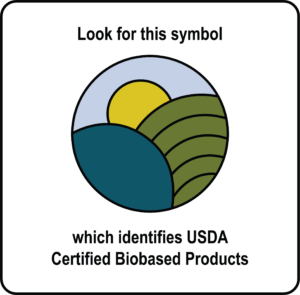
Bio-based, or more specifically plant-based, raw materials are often cited as eco-friendly raw materials for paints. These materials reduce the carbon footprint of the coatings made from them in two ways. First, since they are derived from plants, they contain CO2 captured from the atmosphere during photosynthesis. Second, they take the place of petroleum-based raw materials which release fossil carbon upon extraction. The use of branding which identifies those products made with bio-based materials can help consumers decide to choose a more eco-friendly product. The United States Department of Agriculture certifies products with bio-based content, including paints, under its BioPreferred program.
 The final step in making a coating eco-friendly is considering the fate of the coating at the end of its useful life. Coating films on finished objects are not usually recycled since the goal of recycling is to recover the value of the substrate material. By formulating coatings which do not interfere with or complicate the recycling process, the chemist enables the circular economy. A circular economy, where most end-of-life objects are recycled or reused, is an important sustainable development metric. The journey to eco-friendly coatings is ongoing with evolving targets and methods to meet those goals.
[1] https://www.merriam-webster.com/dictionary/eco-friendly

The views, opinions and technical analyses presented here are those of the author or advertiser, and are not necessarily those of ULProspector.com or UL Solutions. The appearance of this content in the UL Prospector Knowledge Center does not constitute an endorsement by UL Solutions or its affiliates.
All content is subject to copyright and may not be reproduced without prior authorization from UL Solutions or the content author.
The content has been made available for informational and educational purposes only. While the editors of this site may verify the accuracy of its content from time to time, we assume no responsibility for errors made by the author, editorial staff or any other contributor.
UL Solutions does not make any representations or warranties with respect to the accuracy, applicability, fitness or completeness of the content. UL Solutions does not warrant the performance, effectiveness or applicability of sites listed or linked to in any content.