

Part 2 of 2 (see Part 1 here)
 Like them or not, artificial intelligence (AI) data centers have undeniable growth prospects. The construction boom related to the build-out of these often massive facilities is real, and several material suppliers are riding that wave.
Aurora Material Solutions (AMS) is active in this sector, as are firms such as SABIC, Envalior, Covestro and Geon, to name but a few. In a mid-July webinar hosted by UL Solutions, Megan Kravec, industrial market and product manager for Streetsboro, Ohio-based AMS, provided a big-picture overview of this booming sector.
She outlined the unique demands of these data centers. Constant operation, escalating heat loads, advanced cooling systems, heavy vibration, and stringent fire-safety requirements create challenges that ordinary materials aren’t designed to handle.
AMS supplies rigid and flexible PVC as well as various custom-engineered polymer compounds. The applications are broad and demanding. Kravec detailed some of the key elements in these centers (with the types of its materials used in these instances):
* Cooling infrastructure: Cooling systems play a critical role in managing heat, particularly in AI-driven data centers with high power densities. Without effective thermal management, equipment reliability and operational stability are at risk. (PVC, CPVC, PC, ABS)
* Computing Equipment: Computing is the heart of a data center, and components must not only be durable but also high-performing. They require engineered polymers that offer superior thermal stability, electrical insulation, UL-rated flame retardancy approvals, and structural integrity. (PC & PC Alloys, ABS)
* Networking Components: Networking equipment keeps the data center connected and secure. Materials must provide durability and structural integrity without causing interference in this high-bandwidth networking infrastructure. (Flexible PVC, PBT, PC & PC Alloys, ABS, PEI)
* Physical Infrastructure: This encompasses the building itself and all the systems inside. Typical applications include drainage and containment, airflow management, instrumentation and controls, grounding systems, access control panels, cable management and raised floor systems. (Flexible PVC, PC & PC Alloys)
* Storage: These systems –– including such items as servers, hard disk drives, enclosures and chassis –– are vital for data retention and management. They need to be able to withstand various structural, vibration and thermal challenges. (Flexible PVC, PC, ABS)
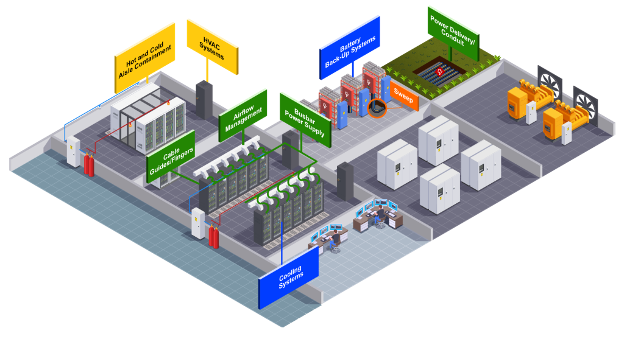
* Monitoring and Control Systems: Facility monitoring enables real-time operational intelligence. Materials must provide durability and precision while supporting electronic
components and enhancing system responsiveness –– all while complying with building codes and other standards. (PC, PC/ABS, ABS, PBT)
* Power Systems: This segment forms the electrical backbone of a data center, making its components essential for continuous operation and overall facility uptime. (Flexible PVC, PC, PBT, PEI)
* Security Systems: Security design is a key component of the TIA-942 standard. The materials used must provide the durability needed to protect people, property and high-value equipment in applications ranging from closed-circuit TV to video surveillance and perimeter fencing. (Rigid PVC, PC, ABS, PBT)
* Fire and Life Safety: This includes smoke detectors, fire suppression systems and fire alarm panels –– everything that protects personnel and critical assets from fire hazards. (CPVC, PC, ABS)
In the July webinar, Kravec teamed with Mike Schaefer, commercial director – data centers for Hastings, Minn.-based molder Intek Plastics. Schaefer explained how AI infrastructure “raises the bar” when it comes to material choice. “Higher density increases heat. More power adds complexity, and tighter tolerances are required.” Addressing these challenges requires integrated collaboration, he added.
Discover how UL Solutions supports data centers with safety, security, sustainability, performance and market access offerings, learn more here!
Dr. Matthew Hartline, Intek’s research and development manager, also has written a white paper on the topic. In it, Hartline states: “When selecting engineered plastics for data center applications, it is critical to identify any required ratings or certification standards that the material must meet. These may include UL certifications associated with electrical properties, thermal performance and flammability, which ensure the material’s safety and reliability.”
As noted at the outset, other material suppliers also are active in this space.
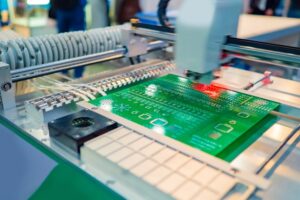
* Saudi Arabia-based SABIC announced last December that it was expanding production capacity for specialty oligomers based on polyphenylene (PPE) technology. It said at the time that “The commitment builds on previous capacity increases in Asia and meets with the rapidly growing demand for high-performance printed circuit boards (PCBs) in data centers serving the needs of artificial intelligence (AI) and 5G applications.”
Beyond PPE oligomers, SABIC offers a wide range of specialty resins and compounds with benefits such as lightweight strength, thermal and electrical conductivity, optical clarity, chemical resistance, and cooling capabilities. These include polyetherimide (PEI) in applications such as fiber-optic connectors, cooling fans, liquid cooling connections, and on-board optics; polycarbonate copolymers for busbar covers; and acetal copolymers for anti-static components.
* Geon Performance Solutions LLC notes that its PVC and flame-resistant compounds, including plenum-grade formulations engineered to UL 444, UL 910, and NFPA 262 standards, support the power distribution and communications cabling upon which data centers depend.
* Envalior GmbH –– formed in April 2023 as a joint venture combining DSM Engineering Materials and Lanxess High Performance Materials –– offers a portfolio of advanced materials used in data centers, among other sectors. Its nylon 66 and polyphenylene sulfide (PPS) resins, for example, provide the high heat resistance, hydrolysis resistance, and dimensional stability required across liquid-cooling and air-cooling applications. Ultrathin e-motor insulation made with its overmolded nylon 46 resin provides higher torque density without increasing the motor envelope size, particularly relevant for data center cooling fans, as well as robotics, drones, and high-end power tools.
* Germany’s Covestro AG notes that “AI clusters push power, cooling and networking beyond what conventional data center architectures can handle. Unlike conventional workloads, AI training and inference create rapid, unpredictable load fluctuations, requiring power distribution and battery backup systems to respond quickly, and intelligent control systems to monitor and manage stability in real time.
“At the same time,” the company continues, “thousands of high-performance GPUs [graphic processing units] run at full load for extended periods, creating extreme requirements for absolute performance, fast internal communication and sustained stability. Purpose-built AI data centers therefore seek to break through these limits and deliver more computing performance per watt.”
Covestro says its polycarbonate and flame-retardant polycarbonate grades meet UL 94 V-0 requirements and offer long-term heat resistance, while its glass-fiber reinforced options add stiffness and impact strength for robust housings. Robust and thermally conductive materials find use in a variety of other end-use applications.
These are among the reasons that groups such as India’s Precedence Research are projecting the global data center plastics market will soar from $1.5 billion in 2025 to $5.84 billion in 2035. Much can happen in this fast-changing sector, but it seems certain that demand for polymers that can meet AI’s harsh requirements stands to benefit significantly.

The views, opinions and technical analyses presented here are those of the author or advertiser, and are not necessarily those of ULProspector.com or UL Solutions. The appearance of this content in the UL Prospector Knowledge Center does not constitute an endorsement by UL Solutions or its affiliates.
All content is subject to copyright and may not be reproduced without prior authorization from UL Solutions or the content author.
The content has been made available for informational and educational purposes only. While the editors of this site may verify the accuracy of its content from time to time, we assume no responsibility for errors made by the author, editorial staff or any other contributor.
UL Solutions does not make any representations or warranties with respect to the accuracy, applicability, fitness or completeness of the content. UL Solutions does not warrant the performance, effectiveness or applicability of sites listed or linked to in any content.